A synonym for cannon is an essential phrase for writers describing military artillery, heavy weapons, or historic battlefields.
Yesterday, Marcus wrote a fantasy story about an epic naval battle, but he kept repeating the word when describing heavy ship weapons.
Finding a fitting synonym for cannon elevates your creative writing, helping you describe exact artillery types, weapon sizes, and military eras effortlessly.
Consequently, knowing every useful synonym for cannon helps students, bloggers, fiction authors, and daily English speakers communicate with vivid precision.
What Does “Cannon” Really Mean?
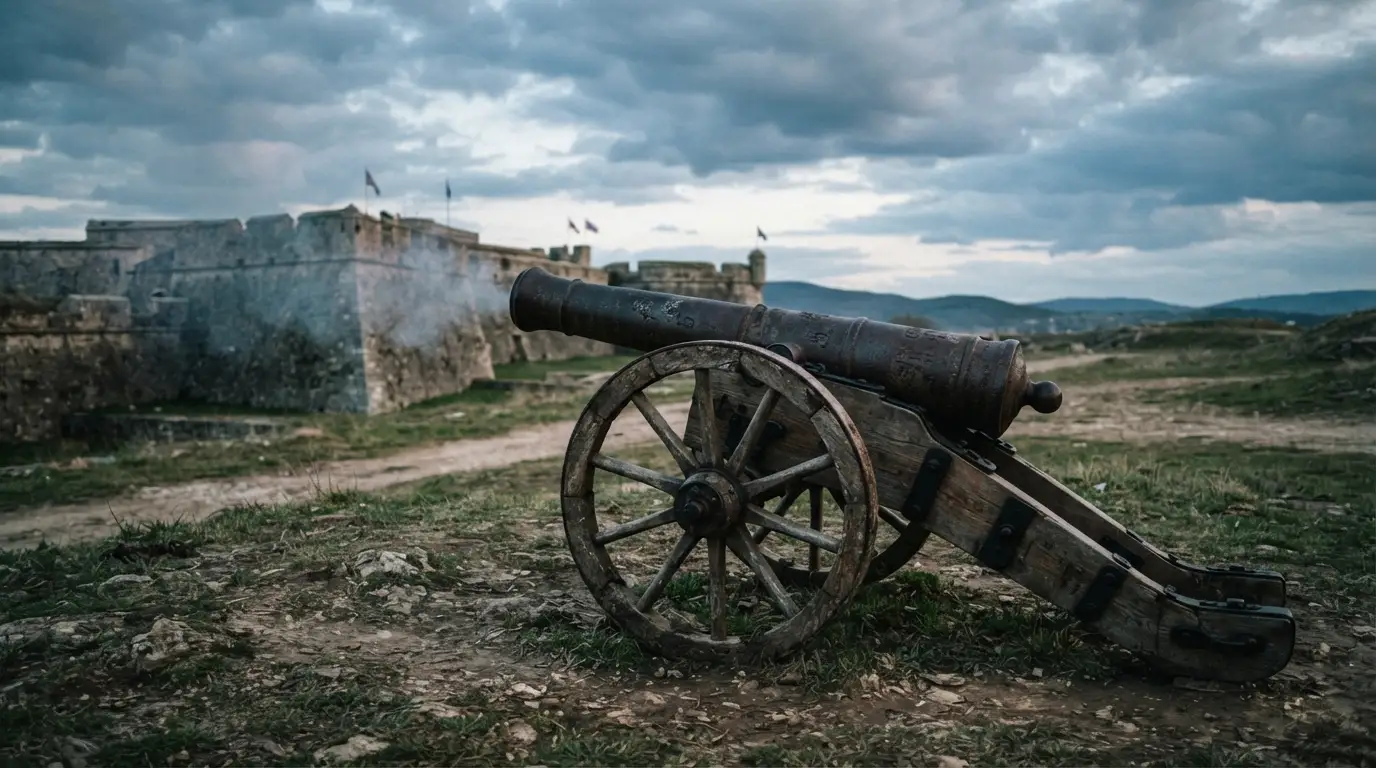
“Cannon” refers to a heavy, large-caliber piece of artillery that uses gunpowder or explosive charges to launch heavy projectiles over distance.
It carries a powerful, forceful, and historical tone that suggests loud explosions, heavy military defense, and devastating wall-shattering firepower.
Native speakers understand it as a serious, heavy weapon, whether referring to historic iron guns on ships or modern automated aircraft cannons.
You will encounter this term in history textbooks, military reports, fantasy novels, and action movies.
- Part of Speech: Noun (Countable)
- Definition: A large, heavy piece of artillery, typically mounted on wheels or a carriage, used in warfare to fire heavy projectiles.
Connotative Meaning
Connotation is the emotional feeling or idea that a word evokes beyond its literal meaning (the emotional tone or attitude a word carries).
- Positive tone: Evokes impressive engineering, grand historical heritage, decisive defense, and awe-inspiring strength.
- Negative tone: Can feel destructive, violent, terrifying, loud, and associated with war and devastation.
- Neutral tone: Simply describes a specific category of large-caliber military artillery or mechanical launch equipment.
Etymology
The word originates from the Old French canon, which derived from the Italian cannone, meaning a large tube or hollow pipe.
- Old English (450–1100): The word was not present because gunpowder artillery had not yet been invented in Western Europe.
- Middle English (1100–1500): Entered the language in the late 14th century as heavy artillery began appearing on European battlefields.
- Modern English (1500–Present): Expanded to describe high-caliber automatic guns mounted on military aircraft, armored vehicles, and naval vessels.
Pronunciation (US & UK)
- US: /ˈkæn.ən/
- UK: /ˈkæn.ən/
Syllables & Affixation
- Syllable Break: can – non
- Root: cannon (from Latin canna, meaning reed or tube)
- Prefix: None
- Suffix: None
Synonyms List
Artillery (Noun) — US: /ɑːrˈtɪl.ɚ.i/ | UK: /ɑːˈtɪl.ər.i/
Meaning: Heavy military weapons that fire large projectiles across long distances.
Tone/Register: Formal, Military, Professional
Examples:
The army positioned heavy artillery along the high ridge before dawn.
Soldiers maintained their artillery weapons to ensure constant readiness during drills.
Ordnance (Noun) — US: /ˈɔːrd.nəns/ | UK: /ˈɔːd.nəns/
Meaning: General military supplies including heavy weapons, ammunition, and explosives.
Tone/Register: Highly Formal, Military, Official
Examples:
Specialists inspected the stored ordnance inside the underground bunker.
The naval vessel was fully stocked with heavy ordnance before departing.
Howitzer (Noun) — US: /ˈhaʊ.ɪt.sɚ/ | UK: /ˈhaʊ.ɪt.sə/
Meaning: A specialized short-barrel cannon designed to fire shells at high trajectories.
Tone/Register: Technical, Military, Specific
Examples:
The regiment fired the howitzer over the steep mountain ridge.
Mechanics serviced the high-tech howitzer to keep it fully operational.
Mortar (Noun) — US: /ˈmɔːr.t̬ɚ/ | UK: /ˈmɔː.tə/
Meaning: A short, light muzzle-loading cannon that fires explosive shells at steep angles.
Tone/Register: Military, Technical, Tactical
Examples:
In response, infantry forces launched a light mortar shell toward the enemy camp.
The team set up the portable mortar behind a low wall.
Field Gun (Noun) — US: /ˈfiːld ɡʌn/ | UK: /ˈfiːld ɡʌn/
Meaning: A mobile cannon mounted on wheels for easy transport across open battlefields.
Tone/Register: Historical, Military, Descriptive
Examples:
Museum guides preserved the nineteenth-century field gun for historical tours.
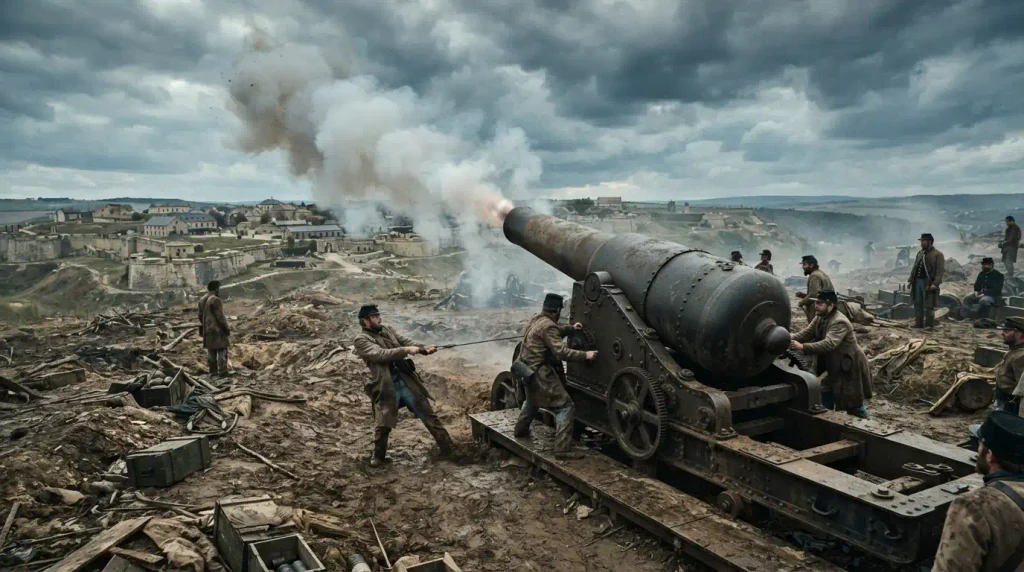
Horses pulled the iron field gun across the muddy valley.
Gun (Noun) — US: /ɡʌn/ | UK: /ɡʌn/
Meaning: A broad term referring to any firearm or large-caliber projectile weapon.
Tone/Register: General, Casual, Everyday
Examples:
Naval officers prepared the primary gun before entering hostile waters.
The ancient fortress fired its ceremonial gun at sunset.
Piece (Noun) — US: /piːs/ | UK: /piːs/
Meaning: A traditional military term referring to an individual heavy artillery weapon.
Tone/Register: Historical, Military, Specialized
Examples:
Commanders inspected every artillery piece line after the morning battle.
The museum displayed a rare iron piece from the wooden warship era.
Carronade (Noun) — US: /ˌkær.əˈneɪd/ | UK: /ˌkær.əˈneɪd/
Meaning: A short, heavy cast-iron cannon historically used on naval warships for close-range combat.
Tone/Register: Historical, Specialized, Nautical
Examples:
The pirate vessel swept the deck using a heavy iron carronade.
Naval historians restored the ship’s historic carronade to its original state.
Big Gun (Noun) — US: /bɪɡ ɡʌn/ | UK: /bɪɡ ɡʌn/
Meaning: An informal, vivid phrase for a massive, powerful artillery piece.
Tone/Register: Informal, Descriptive, Conversational
Examples:
Moreover, the battleship revealed its big guns as it approached the island.
Engineers tested the powerful big gun at the remote firing range.
Great Gun (Noun) — US: /ɡreɪt ɡʌn/ | UK: /ɡreɪt ɡʌn/
Meaning: An old-fashioned historical term for heavy naval or fortress cannons.
Tone/Register: Historical, Literary, Archaic
Examples:
The castle walls shuddered as the enemy’s great gun opened fire.
Sailors polished the brass fittings on the ship’s great gun.
Culverin (Noun) — US: /ˈkʌl.vɚ.ɪn/ | UK: /ˈkʌl.vər.ɪn/
Meaning: A relatively long-barreled medieval cannon used for long-range bombardment.
Tone/Register: Historical, Specialized, Academic
Examples:
Defenders fired the long culverin from the highest tower of the stone castle.
Scholars identified the rusted weapon as a sixteenth-century culverin.
Basilisk (Noun) — US: /ˈbæs.ə.lɪsk/ | UK: /ˈbæs.ɪ.lɪsk/
Meaning: A massive, historical heavy cannon capable of firing enormous stone or iron balls.
Tone/Register: Archaic, Historical, Literary
Examples:
The army transported the gigantic basilisk across the plains using dozens of oxen.
Legends claimed the wall broke only after three hits from the basilisk.
Bombard (Noun) — US: /ˈbɑːm.bɑːrd/ | UK: /ˈbɒm.bɑːd/
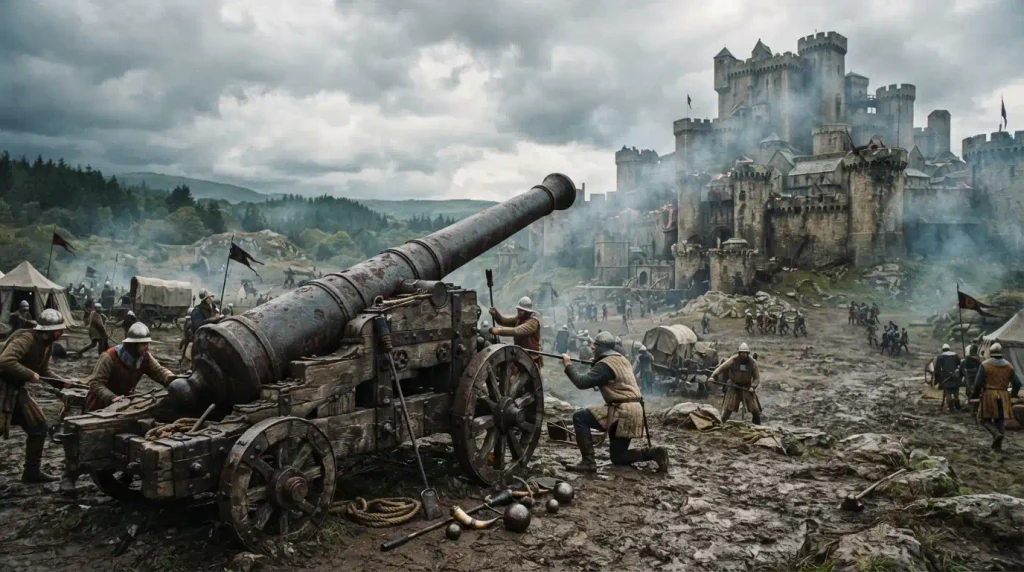
Meaning: An early large-caliber cannon used in medieval warfare to destroy castle walls.
Tone/Register: Historical, Archaic, Specialized
Examples:
Soldiers loaded large stone spheres into the iron bombard.
The ancient bombard cracked the thick fortress gates after several direct hits.
Falconet (Noun) — US: /ˈfɑːl.kə.nət/ | UK: /ˈfɔːl.kə.nət/
Meaning: A light, small-caliber historical cannon used during the late Middle Ages.
Tone/Register: Historical, Academic, Nautical
Examples:
The small merchant vessel mounted a falconet on its rail for anti-pirate defense.
Guards easily maneuvered the light falconet across the narrow ramparts.
Minion (Noun) — US: /ˈmɪn.jən/ | UK: /ˈmɪn.jən/
Meaning: A small Elizabethan-era smoothbore cannon used for antipersonnel combat.
Tone/Register: Historical, Specialized, Rare
Examples:
Gunners positioned the minion along the wooden palisade.
The historical inventory listed a bronze minion among the ship’s defenses.
Saker (Noun) — US: /ˈseɪ.kɚ/ | UK: /ˈseɪ.kə/
Meaning: A medium-sized historical cannon used widely in siege warfare during the sixteenth century.
Tone/Register: Historical, Academic, Literary
Examples:
The battery included a saker capable of firing four-pound iron shot.
Reenactors fired a restored saker during the historical festival.
Autocannon (Noun) — US: /ˈɑː.t̬oʊˌkæn.ən/ | UK: /ˈɔː.təʊˌkæn.ən/
Meaning: A rapid-firing, automatic high-caliber weapon used on modern jets and armored vehicles.
Tone/Register: Modern, Technical, Military
Examples:
The fighter jet fired its internal autocannon during high-speed combat drills.
An armored vehicle scanned the perimeter using a heavy autocannon.
Weaponry (Noun) — US: /ˈwep.ən.ri/ | UK: /ˈwep.ən.ri/
Meaning: All weapons of a particular type or belonging to a collective military unit.
Tone/Register: Formal, General, Professional
Examples:
Consequently, the army upgraded its heavy weaponry to maintain regional security.
Museums exhibit historical weaponry to educate visitors about ancient wars.
Battery (Noun) — US: /ˈbæt̬.ɚ.i/ | UK: /ˈbæt.ər.i/
Meaning: A unit of artillery guns grouped for coordinated military bombardment.
Tone/Register: Military, Strategic, Formal
Examples:
Furthermore, the coastal battery guarded the harbor entrance against foreign ships.
Commanders ordered the entire battery to fire simultaneously.
Cannonade (Noun) — US: /ˌkæn.əˈneɪd/ | UK: /ˌkæn.əˈneɪd/
Meaning: A heavy, continuous bombardment of artillery fire against a position.
Tone/Register: Literary, Dramatic, Military
Examples:
The loud cannonade shattered the morning peace across the valley.
Soldiers took cover inside deep trenches during the intense cannonade.
Long Gun (Noun) — US: /lɑːŋ ɡʌn/ | UK: /lɒŋ ɡʌn/
Meaning: A naval cannon with a long barrel designed for long-distance firing accuracy.
Tone/Register: Nautical, Historical, Technical
Examples:
The captain aligned the long gun to hit distant enemy sails.
Naval shipbuilders installed reinforced decks to support each heavy long gun.
Siege Gun (Noun) — US: /siːdʒ ɡʌn/ | UK: /siːdʒ ɡʌn/
Meaning: A heavy, large-caliber cannon designed specifically to breach massive defensive fortifications.
Tone/Register: Historical, Military, Tactical
Examples:
In addition, the siege gun pounded the stone wall until a gap opened.
Engineers took weeks to haul the massive siege gun up the hill.
Turret Gun (Noun) — US: /ˈtɝː.ət ɡʌn/ | UK: /ˈtʌr.ət ɡʌn/
Meaning: A large-caliber cannon mounted inside a rotating protective housing on ships or tanks.
Tone/Register: Modern, Technical, Military
Examples:
The captain rotated the main turret gun toward the target vessel.
Advanced sensors automatically aim the turret gun during night missions.
Swivel Gun (Noun) — US: /ˈswɪv.əl ɡʌn/ | UK: /ˈswɪv.əl ɡʌn/
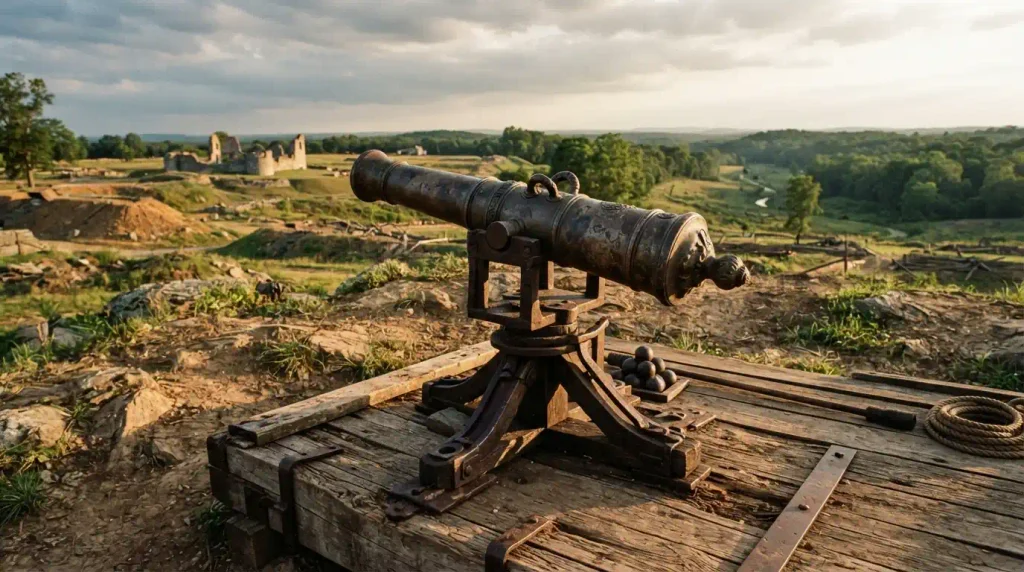
Meaning: A small cannon mounted on a pivot stand that rotates freely in any direction.
Tone/Register: Historical, Nautical, Descriptive
Examples:
The lookout fired the swivel gun to repel incoming boarding skiffs.
Sailors mounted a brass swivel gun on the ship’s stern railing.
Anti-Aircraft Gun (Noun) — US: /ˌæn.t̬iˈer.kræft ɡʌn/ | UK: /ˌæn.tiˈeə.krɑːft ɡʌn/
Meaning: A specialized cannon designed to fire high-explosive shells at airborne targets.
Tone/Register: Modern, Military, Technical
Examples:
In fact, the naval ship activated its automated anti-aircraft gun during radar alerts.
Defenders alternate the anti-aircraft gun along the coastal boundary.
Smoothbore (Noun) — US: /ˈsmuːð.bɔːr/ | UK: /ˈsmuːð.bɔː/
Meaning: A cannon or firearm that has an unrifled, smooth inner barrel surface.
Tone/Register: Historical, Technical, Academic
Examples:
The old iron smoothbore was less accurate than modern rifled artillery.
Historians studied the bronze smoothbore retrieved from the shipwreck.
Naval Gun (Noun) — US: /ˈneɪ.vəl ɡʌn/ | UK: /ˈneɪ.vəl ɡʌn/
Meaning: A heavy cannon installed specifically on warships for shore bombardment and sea combat.
Tone/Register: Formal, Technical, Nautical
Examples:
The warship tested its main naval gun during offshore military exercises.
Engineers overhauled the hydraulic systems of the primary naval gun.
Heavy Gun (Noun) — US: /ˈhev.i ɡʌn/ | UK: /ˈhev.i ɡʌn/
Meaning: An artillery weapon capable of firing massive shells with exceptional destructive force.
Tone/Register: General, Military, Descriptive
Examples:
As a result, the sound of the heavy gun echoed across the mountain pass.
Generals deployed the heavy gun to neutralize fort defenses.
Anti-Tank Gun (Noun) — US: /ˌæn.t̬iˈtæŋk ɡʌn/ | UK: /ˌæn.tiˈtæŋk ɡʌn/
Meaning: A high-velocity artillery piece designed specifically to penetrate thick armor on combat vehicles.
Tone/Register: Modern, Military, Tactical
Examples:
Infantry forces concealed the anti-tank gun in the thick tree line.
The crew recalibrated the sights on their anti-tank gun before dawn.
Direct-Fire Gun (Noun) — US: /daɪˈrekt faɪr ɡʌn/ | UK: /dɪˈrekt faɪə ɡʌn/
Meaning: An artillery weapon designed to aim directly at targets within line of sight.
Tone/Register: Technical, Tactical, Military
Examples:
Commanders ordered the direct-fire gun to clear the road barrier ahead.
The tactical unit positioned a direct-fire gun near the town square entrance.
Railway Gun (Noun) — US: /ˈreɪl.weɪ ɡʌn/ | UK: /ˈreɪl.weɪ ɡʌn/
Meaning: A massive historical artillery weapon mounted on specialized railway carriages for mobility.
Tone/Register: Historical, Rare, Technical
Examples:
Moreover, the railway gun could bombard enemy targets dozens of miles away.
Engineers built custom tracks to support the weight of the railway gun.
Shore Battery (Noun) — US: /ˈʃɔːr ˌbæt̬.ɚ.i/ | UK: /ˈʃɔː ˌbæt.ər.i/
Meaning: A group of heavy cannons installed along a coastline to protect against enemy ships.
Tone/Register: Military, Nautical, Historical
Examples:
The shore battery defended the harbor from incoming enemy forces.
Tourists explored the concrete bunkers of the historic shore battery.
Machine Cannon (Noun) — US: /məˈʃiːn ˌkæn.ən/ | UK: /məˈʃiːn ˌkæn.ən/
Meaning: An early or technical term for a fully automatic heavy cannon.
Tone/Register: Technical, Historical, Military
Examples:
In addition, the defensive bunker held a high-speed machine cannon.
Designers tested the firing rate of the new machine cannon prototype.
Coast Gun (Noun) — US: /ˈkoʊst ɡʌn/ | UK: /ˈkəʊst ɡʌn/
Meaning: A stationary heavy cannon designed specifically for coastal defense.
Tone/Register: Historical, Military, Descriptive
Examples:
The ancient coast gun pointed out toward the open sea.
Local authorities preserved the iron coast gun as a historic landmark.
Field Artillery (Noun) — US: /ˈfiːld ɑːrˌtɪl.ɚ.i/ | UK: /ˈfiːld ɑːˌtɪl.ər.i/
Meaning: Mobile heavy weapons designed to support ground troops during active battlefield maneuvers.
Tone/Register: Military, Strategic, Formal
Examples:
The army advanced under the protective shield of field artillery.
Spotters provided target coordinates to the field artillery crew.
Heavy Artillery (Noun) — US: /ˈhev.i ɑːrˈtɪl.ɚ.i/ | UK: /ˈhev.i ɑːˈtɪl.ər.i/
Meaning: Large-caliber long-range guns used for destructive strategic bombardment.
Tone/Register: Military, Strategic, Formal
Examples:
The command unit deployed heavy artillery to weaken enemy fort defenses.
Loud explosions echoed as the heavy artillery began firing.
Light Artillery (Noun) — US: /laɪt ɑːrˈtɪl.ɚ.i/ | UK: /laɪt ɑːˈtɪl.ər.i/
Meaning: Smaller, easily transportable cannon units used for rapid troop maneuvers.
Tone/Register: Military, Tactical, Technical
Examples:
In addition, light artillery moved quickly across the narrow mountain bridge.
Soldiers reloaded the light artillery piece within seconds.
Coastal Artillery (Noun) — US: /ˈkoʊ.stəl ɑːrˈtɪl.ɚ.i/ | UK: /ˈkəʊ.stəl ɑːˈtɪl.ər.i/
Meaning: Heavy cannons installed permanently along sea borders to defend harbors.
Tone/Register: Official, Military, Historical
Examples:
The coastal artillery unit monitored all incoming ships at night.
Engineers restored the century-old coastal artillery station.
Naval Battery (Noun) — US: /ˈneɪ.vəl ˌbæt̬.ɚ.i/ | UK: /ˈneɪ.vəl ˌbæt.ər.i/
Meaning: An organized arrangement of heavy guns mounted on warships or naval bases.
Tone/Register: Nautical, Formal, Military
Examples:
The battleship fired its full naval battery toward the shore.
Naval battery crews completed high-speed targeting drills.
Deck Gun (Noun) — US: /dek ɡʌn/ | UK: /dek ɡʌn/
Meaning: A cannon mounted openly on the main deck of a submarine or warship.
Tone/Register: Nautical, Military, Technical
Examples:
Consequently, the captain ordered the crew to assemble near the main deck gun.
Sailors uncovered the deck gun before entering restricted waters.
Siege Artillery (Noun) — US: /siːdʒ ɑːrˈtɪl.ɚ.i/ | UK: /siːdʒ ɑːˈtɪl.ər.i/
Meaning: Extremely large guns used specifically to destroy fortress walls during blockades.
Tone/Register: Historical, Academic, Military
Examples:
The invading army assembled its siege artillery outside the city wall.
Heavy wooden wagons hauled the siege artillery across the mud.
Ship’s Gun (Noun) — US: /ʃɪps ɡʌn/ | UK: /ʃɪps ɡʌn/
Meaning: Any cannon or heavy artillery piece permanently assigned to a wooden or steel warship.
Tone/Register: Descriptive, Nautical, General
Examples:
Furthermore, every ship’s gun was secured firmly with heavy rope harness.
The museum preserved an iron ship’s gun salvaged from the seabed.
Fortress Gun (Noun) — US: /ˈfɔːr.trəs ɡʌn/ | UK: /ˈfɔː.trəs ɡʌn/
Meaning: A heavy stationary cannon installed on castle walls or stone forts for defense.
Tone/Register: Historical, Descriptive, Military
Examples:
The fortress gun commanded a complete view of the valley below.
Defenders loaded the fortress gun with heavy iron cannonballs.
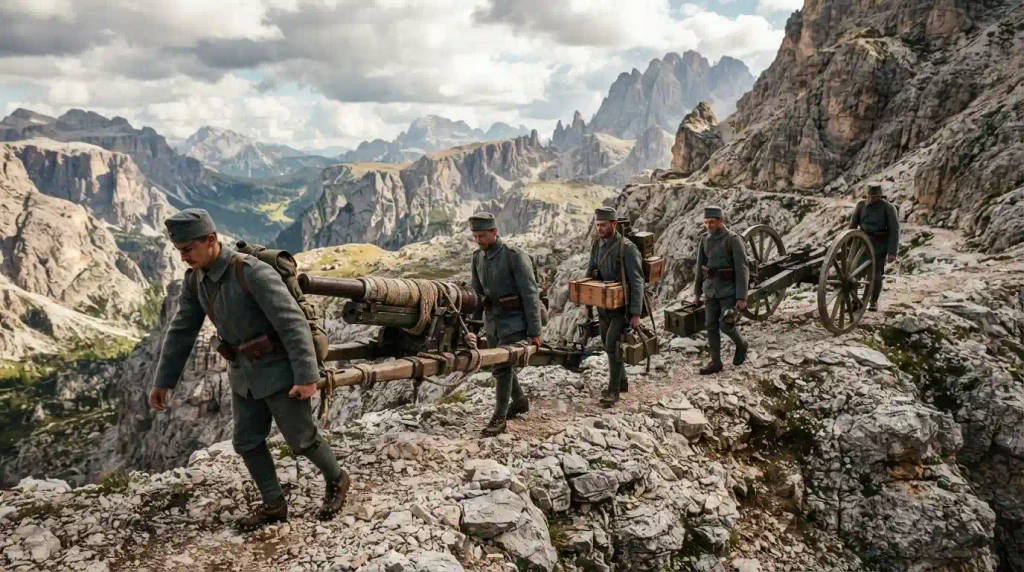
Mountain Gun (Noun) — US: /ˈmaʊn.tən ɡʌn/ | UK: /ˈmaʊn.tɪn ɡʌn/
Meaning: A lightweight cannon designed to be disassembled and transported over rough mountain terrain.
Tone/Register: Tactical, Technical, Military
Examples:
In fact, soldiers carried the mountain gun in parts up the rocky ridge.
The artillery team assembled the mountain gun in under five minutes.
Anti-Material Gun (Noun) — US: /ˌæn.t̬i.məˈtɪr.i.əl ɡʌn/ | UK: /ˌæn.ti.məˈtɪə.ri.əl ɡʌn/
Meaning: A high-caliber modern heavy gun intended to destroy military equipment and vehicles.
Tone/Register: Modern, Technical, Tactical
Examples:
Moreover, the sniper unit utilized an anti-material gun to target enemy radar dishes.
Engineers designed the anti-material gun to penetrate thick metal barriers.
Synonyms by Tone
Positive
- Ordnance: Sounds formal, official, structured, and professionally managed.
- Autocannon: Evokes high technology, precision engineering, and modern military efficiency.
- Field Artillery: Connotes tactical discipline, organized defense, and military excellence.
Neutral
- Artillery: Standard, balanced term for heavy projectile weaponry.
- Gun: Simple, functional everyday word with zero dramatic flair.
- Battery: Objective military classification for a grouping of weapons.
Negative / Restrictive
- Bombard: Evokes wall-smashing destruction, chaos, and ancient siege violence.
- Siege Gun: Associated with long, agonizing blockades and town destruction.
Playful / Informal
- Big Gun: Energetic and casual slang for massive weaponry or influential leaders.
Mini Comparison
Cannon vs. Artillery vs. Howitzer
| Synonym | Core Meaning | Tone | Best Usage |
| Cannon | A heavy, large-caliber projectile gun | Historical / Military | Historic battles, naval ships, fantasy writing |
| Artillery | Collective term for heavy ranged weapons | Formal / Strategic | Military reports, tactical news, army operations |
| Howitzer | Cannon firing shells at high angles | Technical / Modern | Tactical military fiction, modern combat analysis |
Use cannon when focusing on individual historic or iconic weapons. Choose artillery when describing army units or combined firepower. Use howitzer when specifying precise high-angle trajectory weapons.
Context-Based Usage
Daily Conversation
In casual speech, people rarely discuss military weapons. However, idioms like “big guns” appear naturally when referring to bringing in top experts or executive leaders to solve a problem.
- Example: “Therefore, management brought in the big guns to finish the project on time.”
Writing and Blogging
When writing web content, history blogs, or book reviews, writers want visual terms. Consequently, terms like artillery or field gun help paint clear pictures for readers.
- Example: “Furthermore, the museum features a restored field gun from the nineteenth century.”
Professional and Academic Tone
In formal academic research, military history, or legal texts, precise terminology is mandatory. Thus, phrases like ordnance, battery, or field artillery fit best.
- Example: “As a result, the garrison deployed its coastal battery to secure the bay.”
Common Mistakes & Native Usage
- Mistake 1: Confusing canon (with one ‘n’) and cannon (with two ‘n’s). A canon is a rule, principle, or body of official work, whereas a cannon is a heavy artillery weapon.
- Mistake 2: Using howitzer for historic pirate ship weapons. Pirate ships carried smoothbore cannons or carronades, not high-trajectory modern howitzers.
- Mistake 3: Using artillery to describe a single rifle. Artillery refers exclusively to heavy, large-caliber weapons and collective military battery units.
Register Note: In spoken English, short terms like gun or informal phrases like big gun are common. However, in formal military history writing, terms like ordnance and field artillery dominate. For deeper insights on language registers, reviewing formal writing style guides can expand your vocabulary skills.
Real-Life Mini Scenarios
Workplace
When a company faces a tough deadline, managers bring in senior specialists. Consequently, team members say the company is “bringing in the big guns” to win the contract.
Social Situations
While visiting a maritime museum, friends admire an ancient wooden ship. As a result, they stop to photograph the restored naval carronade on the top deck.
Media & Pop Culture
Action movies and military video games frequently feature high-tech combat jets. Therefore, viewers instantly recognize the devastating firing rate of an automatic autocannon.
Interactive Practice Quiz
Test your understanding of tone, context, and word choice with these scenario-based questions.
- Which word refers to a rule or accepted body of work rather than a weapon?
a) Cannon
b) Canon
c) Ordnance
d) Howitzer - What is the main tone of the term “ordnance”?
a) Playful
b) Highly formal and official
c) Archaic
d) Casual - Select the best modern term for a jet aircraft’s rapid-firing gun:
a) Bombard
b) Autocannon
c) Culverin
d) Saker - Which word works best for a four-wheeled mobile cannon on a battlefield?
a) Field gun
b) Swivel gun
c) Carronade
d) Mortar - What term refers to a group of artillery weapons operating together?
a) Swivel
b) Battery
c) Minion
d) Falconet - “Management decided to bring in the big _____ to win the deal.”
a) Bombards
b) Guns
c) Sakers
d) Mortars - Which historical weapon was designed specifically to smash castle walls?
a) Autocannon
b) Bombard
c) Machine cannon
d) Swivel gun - What is the key difference between “cannon” and “artillery”?
a) Cannon is a collective term
b) Artillery is a collective category
c) Cannon is modern only
d) Artillery is an informal slang word - Which term describes a short naval cannon used for close combat?
a) Carronade
b) Railway gun
c) Anti-aircraft gun
d) Culverin - Choose the term most suitable for an official military inventory report:
a) Big gun
b) Ordnance
c) Cannonade
d) Great gun
Application Task: Write a short, two-sentence story scene using the synonym artillery.
Answer Key: 1-b, 2-b, 3-b, 4-a, 5-b, 6-b, 7-b, 8-b, 9-a, 10-b
Frequently Asked Questions
1. What is the most common synonym for cannon in history writing?
The word artillery or field gun is the most common and versatile choice in history writing. In addition, when describing grouped weapons, historians frequently use the term battery.
2. Is there a difference between cannon and canon?
Yes, cannon with two ‘n’s is a heavy artillery weapon. Conversely, canon with one ‘n’ means a rule, official law, or accepted collection of literary works.
3. What is an autocannon used for today?
An autocannon is a modern automatic weapon firing explosive shells. Consequently, it is mounted on fighter jets, attack helicopters, and armored combat vehicles for rapid firepower.
4. Can I use the term “big guns” in business writing?
Yes, “big guns” is a popular business idiom meaning influential experts or executives. However, in formal corporate reports, choose words like senior specialists instead.
5. Why are ship cannons called carronades in naval history?
A carronade was a specific short cast-iron cannon developed in Scotland. As a result, it provided massive close-range firepower while weighing less than standard naval cannons.
6. What does the term “coastal battery” mean?
A coastal battery refers to a group of heavy cannons mounted along a coastline. Consequently, their primary role is defending harbors and sea lanes from hostile ships.
Conclusion
Learning a precise synonym for cannon gives you the power to describe historical battles, modern warfare, and creative stories with vivid authority.
When you select an exact synonym for cannon, such as artillery, howitzer, or battery, your prose instantly gains color, accuracy, and emotional impact.
Mastering every useful synonym for cannon empowers you to write better essays, captivating fiction, and informative blogs with total confidence.
Start using these fresh terms today in your writing, projects, and daily conversations to express your ideas effortlessly!

Sawera Rani is the founder and content creator behind VocabularyFinder.com, a platform designed to help learners improve their English vocabulary simply and effectively. With a passion for language learning, Sawera Rani creates easy-to-understand vocabulary guides, word meanings, definitions, and practical examples that make learning new words easier. She aims to provide useful and reliable resources for students, professionals, and English learners who want to improve their communication skills. Through VocabularyFinder.com, she focuses on making vocabulary learning more accessible, engaging, and helpful for everyday use.