Synonym for aqueduct options allow you to describe water channels, bridges, and transport pipes with extreme accuracy and stylistic polish.
Imagine walking past ancient stone arches in Rome or viewing massive concrete irrigation systems feeding sprawling farmlands. Choosing a precise synonym for aqueduct makes your writing clear.
Learning a rich synonym for aqueduct improves your vocabulary depth significantly. Consequently, students, bloggers, and technical writers replace repetitive terms with ease.
Mastering these descriptive structural words expands your vocabulary confidence rapidly. Furthermore, everyday English speakers can express complex engineering ideas effortlessly in conversation.
What Does “Aqueduct” Really Mean?
The word “aqueduct” refers to an artificial channel, pipe, or elevated bridge built specifically to convey water from a distant source to a target destination. Native speakers use it when discussing historical civil engineering, urban infrastructure, or large-scale agricultural projects. Additionally, you will frequently see it in history textbooks, geography guides, and environmental studies.
Part of Speech: Noun
Definition: An artificial channel or elevated bridge constructed to transport water across long distances, typically relying on gravity.
Connotative Meaning
Words carry distinct emotional associations that influence how your audience interprets your message. (Connotation means the emotional association or cultural feeling a word carries beyond its explicit definition).
- Positive Tone: Highlights remarkable human ingenuity, historical preservation, vital life-sustaining utility, or magnificent architectural achievement.
- Negative Tone: Implies artificial manipulation of natural ecosystems, environmental destruction, industrial scars, or ancient crumbling ruins.
- Neutral Tone: Functions purely as an objective physical description of a pipe, conduit, or water transport channel.
Etymology
The noun “aqueduct” originates directly from the Latin phrase aquae ductus, which literally translates to “a leading or conduit of water.”
- Old English (450–1100): Early speakers used native Germanic compounds like wæter-gelād (water-course) long before Latin imports arrived.
- Middle English (1100–1500): The term entered scholarly manuscripts through Anglo-French aqueduct and classical Latin texts during the late medieval period.
- Modern English (1500–Present): The spelling stabilized as “aqueduct,” becoming the universal standard for both elevated stone arches and modern concrete water conduits.
Pronunciation (US & UK)
- US: /ˈæk.wə.dʌkt/
- UK: /ˈæk.wɪ.dʌkt/
Syllables
aq-ue-duct
Affixation Pattern
- Root: duct (from Latin ducere, meaning “to lead or guide”)
- Prefix: aque- (variant of aqua-, meaning “water”)
- Suffix: None
Synonyms List
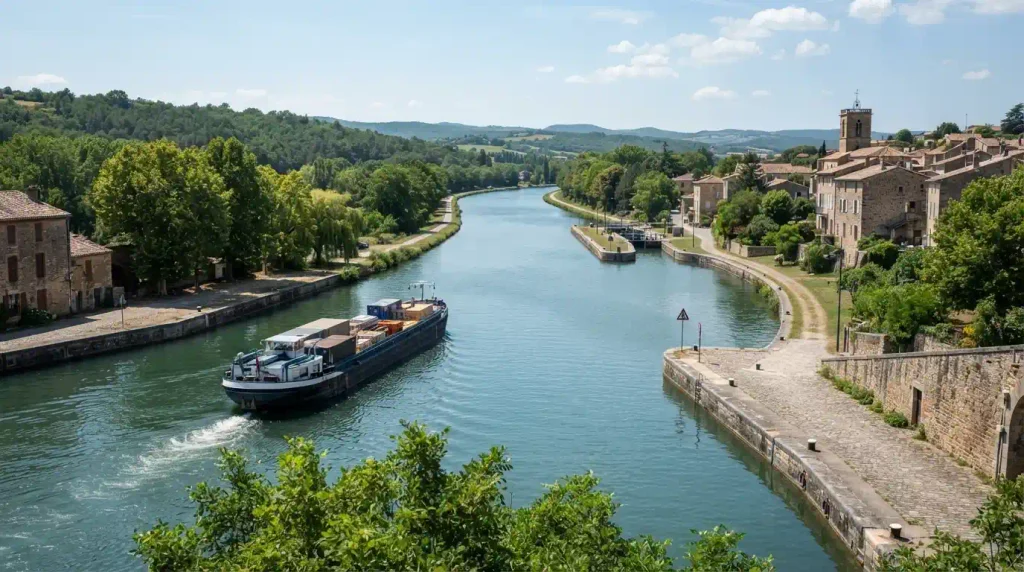
Waterway (Noun) — US: /ˈwɑː.t̬ɚ.weɪ/ | UK: /ˈwɔː.tə.weɪ/
Meaning: A navigable body of water or artificial channel used for transportation and water movement.
Tone/Register: General, Neutral.
Examples:
The cargo barge moved smoothly along the wide inland waterway.
Furthermore, engineers monitored the current to ensure safe passage for ships.
Conduit (Noun) — US: /ˈkɑːn.du.ɪt/ | UK: /ˈkɒn.dju.ɪt/
Meaning: A pipe, tube, or channel through which water or other fluids pass directly.
Tone/Register: Technical, Formal.
Examples:
Workers installed a massive steel conduit beneath the city streets.
As a result, fresh spring water flowed directly into the reservoir.
Canal (Noun) — US: kəˈnæl | UK: kəˈnæl
Meaning: An artificial waterway constructed to allow the passage of boats or to convey water for irrigation.
Tone/Register: General, Geographic.
Examples:
Farmers diverted water from the main canal to nourish their dry crops.
Consequently, the surrounding fields remained green throughout the long summer.
Channel (Noun) — US: /ˈtʃæn.əl/ | UK: /ˈtʃæn.əl/
Meaning: A length of water joining two larger areas or a passage for liquid flow.
Tone/Register: General, Descriptive.
Examples:
Rainwater flowed rapidly down the concrete drainage channel.
It quickly cleared the flooded street after the sudden thunderstorm passed.
Watercourse (Noun) — US: /ˈwɑː.t̬ɚ.kɔːrs/ | UK: /ˈwɔː.tə.kɔːs/
Meaning: A natural or artificial stream, river, or brook along which water flows.
Tone/Register: Formal, Environmental.
Examples:
Environmentalists protected the small watercourse running through the forest valley.
They tested the water clarity every week during the spring season.
Flume (Noun) — US: /fluːm/ | UK: /fluːm/
Meaning: A deep narrow channel or inclined chute with stream water running through it.
Tone/Register: Specialized, Industrial.
Examples:
Logging companies used a wooden flume to transport timber down the mountain.
The rushing water carried heavy logs smoothly toward the sawmills below.
Sluice (Noun) — US: /sloos/ | UK: /sloos/
Meaning: A sliding gate or artificial channel for controlling the flow of water.
Tone/Register: Technical, Historical.
Examples:
The engineer opened the heavy iron sluice to lower the lake level.
Water rushed into the lower valley within seconds of opening.
Culvert (Noun) — US: /ˈkʌl.vɚt/ | UK: /ˈkʌl.vət/
Meaning: A tunnel carrying a stream or open drain under a road or railway track.
Tone/Register: Civil Engineering, Technical.
Examples:
Construction crews replaced the old concrete culvert under the busy highway.
This structural update prevented severe roadway flooding during seasonal rains.
Leat (Noun) — US: /leet/ | UK: /liːt/
Meaning: An artificial water ditch dug to supply water to a mill or reservoir.
Tone/Register: Regional, Historical.
Examples:
The ancient stone mill relied on a narrow leat dug along the hillside.
Consequently, the running water turned the massive wooden wheel smoothly.
Race (Noun) — US: /reɪs/ | UK: /reɪs/
Meaning: A strong or fast current of water, or a channel leading water to a water wheel.
Tone/Register: Historical, Industrial.
Examples:
Water churned violently through the mill race near the old factory.
The strong force generated energy for the village machinery.
Trench (Noun) — US: /trentʃ/ | UK: /trentʃ/
Meaning: A long, narrow ditch dug into the ground for water drainage or piping.
Tone/Register: Casual, General.
Examples:
Gardeners dug a shallow trench along the edge of the vegetable plot.
This simple path directed excess rainwater away from delicate plants.
Ditch (Noun) — US: /dɪtʃ/ | UK: /dɪtʃ/
Meaning: A narrow channel dug at the side of a road or field to hold or carry off water.
Tone/Register: Informal, Everyday.
Examples:
A deep muddy ditch ran parallel to the quiet country lane.
Frogs croaked happily from the wet grass inside the muddy trench.
Pipe (Noun) — US: /paɪp/ | UK: /paɪp/
Meaning: A rigid tubular structure used to convey water, gas, or other fluids.
Tone/Register: Everyday, General.
Examples:
A rusted iron pipe leaked cold water onto the basement floor.
The plumber fixed the joint quickly before damage spread further.
Pipeline (Noun) — US: /ˈpaɪp.laɪn/ | UK: /ˈpaɪp.laɪn/
Meaning: A long line of connected pipes used for conveying water over long distances.
Tone/Register: Industrial, Business.
Examples:
The cross-country pipeline carries fresh drinking water across hundreds of desert miles.
Engineers monitor the pressure continuously using automated computer sensors.
Duct (Noun) — US: /dʌkt/ | UK: /dʌkt/
Meaning: A tube, pipe, or passage for carrying liquid, air, or cable lines.
Tone/Register: Technical, Architectural.
Examples:
Maintenance workers inspected the main water duct inside the complex.
They cleared minor blockages to improve overall flow.
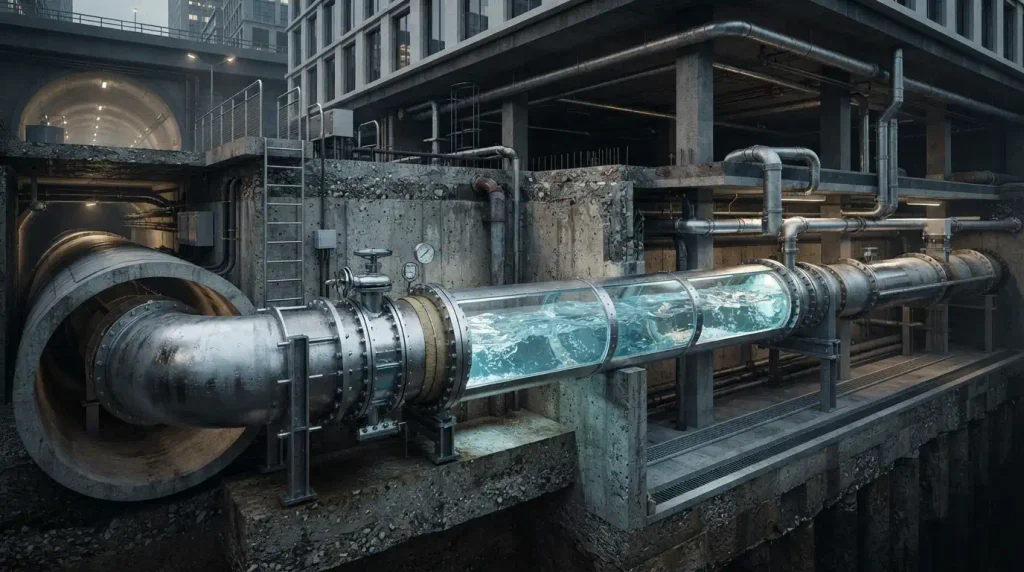
Viaduct (Noun) — US: /ˈvaɪ.ə.dʌkt/ | UK: /ˈvaɪ.ə.dʌkt/
Meaning: A long bridge-like structure carrying a road, railway, or channel across a valley.
Tone/Register: Architectural, Formal.
Examples:
The passenger train crossed the towering stone viaduct high above the river gorge.
Passengers admired the breathtaking mountain scenery from their seats.
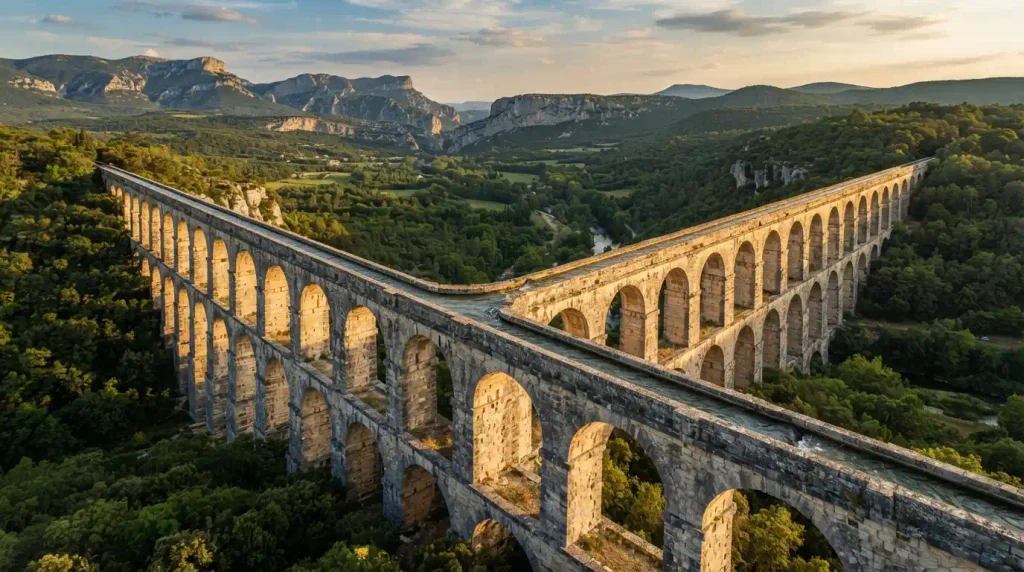
Aqueduct Bridge (Noun) — US: /ˈæk.wə.dʌkt brɪdʒ/ | UK: /ˈæk.wɪ.dʌkt brɪdʒ/
Meaning: An elevated bridge built specifically to carry a water channel across valleys.
Tone/Register: Descriptive, Architectural.
Examples:
Tourists photographed the impressive aqueduct bridge standing against the sunset.
The double-arched structure survived intact for over two centuries.
Drain (Noun) — US: /dreɪn/ | UK: /dreɪn/
Meaning: A channel or pipe designed to carry off surplus liquid or waste water.
Tone/Register: Everyday, Practical.
Examples:
Leaves clogged the storm drain at the corner of the parking lot.
Therefore, city workers cleared the metal grate before heavy storms hit.
Gutter (Noun) — US: /ˈɡʌt̬.ɚ/ | UK: /ˈɡʌt.ər/
Meaning: A shallow trough along a roof edge or street to carry off rainwater.
Tone/Register: Casual, Everyday.
Examples:
Rain poured rapidly from the broken roof gutter during the afternoon storm.
Homeowners cleaned out trapped autumn leaves the following morning.
Trough (Noun) — US: /trɑːf/ | UK: /trɒf/
Meaning: A long, narrow open container or artificial channel holding or carrying liquids.
Tone/Register: Agricultural, Practical.
Examples:
The farmer constructed a wooden trough to direct river water to the pens.
Animals gathered around the long container during the hot afternoon.
Course (Noun) — US: /kɔːrs/ | UK: /kɔːs/
Meaning: The route or path along which a stream or water channel flows.
Tone/Register: Literary, Geography.
Examples:
The river altered its original course after the sudden rockslide.
Consequently, a new lake formed in the peaceful valley nearby.
Aqueduct Line (Noun) — US: /ˈæk.wə.dʌkt laɪn/ | UK: /ˈæk.wɪ.dʌkt laɪn/
Meaning: The entire continuous network system of channels carrying municipal water supply.
Tone/Register: Technical, Civil Planning.
Examples:
City planners expanded the regional aqueduct line to support new suburbs.
This project ensured reliable utility connections for thousands of households.
Feed (Noun) — US: /fiːd/ | UK: /fiːd/
Meaning: A supply channel or line bringing water directly to a machine or reservoir.
Tone/Register: Technical, Mechanical.
Examples:
Engineers checked the main water feed powering the hydroelectric plant.
A steady flow ensured uninterrupted electricity generation for the town.
Siphon (Noun) — US: /ˈsaɪ.fən/ | UK: /ˈsaɪ.fən/
Meaning: A tube used to transfer liquid upward over an obstacle to a lower level.
Tone/Register: Scientific, Technical.
Examples:
The inverted siphon carried mountain water under the highway safely.
Pressure differences allowed the liquid to rise smoothly on the far side.
Headrace (Noun) — US: /ˈhed.reɪs/ | UK: /ˈhed.reɪs/
Meaning: A canal or channel leading water directly to a water wheel or turbine.
Tone/Register: Industrial, Historical.
Examples:
Turbid water rushed down the stone headrace toward the gristmill.
The wheel turned quickly, grinding wheat into fine flour effortlessly.
Tailrace (Noun) — US: /ˈteɪl.reɪs/ | UK: /ˈteɪl.reɪs/
Meaning: A channel leading water away from a water wheel, mill, or turbine.
Tone/Register: Technical, Historical.
Examples:
Excess water discharged smoothly into the river through the stone tailrace.
This mechanism kept the mill cellar completely free from flooding.
Water Main (Noun) — US: /ˈwɑː.t̬ɚ meɪn/ | UK: /ˈwɔː.tə meɪn/
Meaning: A principal pipe in a system of water distribution pipes.
Tone/Register: Practical, Urban Planning.
Examples:
Crews worked through the night to repair a burst water main under First Avenue.
Furthermore, nearby residents received bottled water during the repairs.
Penstock (Noun) — US: /ˈpen.stɑːk/ | UK: /ˈpen.stɒk/
Meaning: An enclosed pipe or sluice gate that delivers water to hydroelectric turbines.
Tone/Register: Specialized, Engineering.
Examples:
High-pressure water surged down the steel penstock toward the power plant.
Operators monitored control valves to prevent sudden surges.
Spillway (Noun) — US: /ˈspɪl.weɪ/ | UK: /ˈspɪl.weɪ/
Meaning: A channel or passage for carrying off surplus water from a dam.
Tone/Register: Civil Engineering, Technical.
Examples:
Engineers opened the concrete spillway as water levels rose behind the dam.
Consequently, the extra volume flowed safely into the riverbed below.
Aqueduct Network (Noun) — US: /ˈæk.wə.dʌkt ˈnet.wɝːk/ | UK: /ˈæk.wɪ.dʌkt ˈnet.wɜːk/
Meaning: An interconnected system of multiple aqueducts supplying an entire region.
Tone/Register: Academic, Formal.
Examples:
Ancient Rome was famous for its expansive municipal aqueduct network.
It transported millions of gallons of fresh water daily to public baths.
Runnel (Noun) — US: /ˈrʌn.əl/ | UK: /ˈrʌn.əl/
Meaning: A small stream, brook, or tiny artificial water channel.
Tone/Register: Literary, Poetic.
Examples:
A clear runnel carved its way through the mossy stone steps.
The tranquil sound of trickling water filled the mountain garden.
Rill (Noun) — US: /rɪl/ | UK: /rɪl/
Meaning: A very small brook, rivulet, or shallow channel carrying water.
Tone/Register: Literary, Descriptive.
Examples:
Spring snowmelt formed a tiny rill that trickled down the steep slope.
It eventually merged with the larger river flowing through the valley.
Rivulet (Noun) — US: /ˈrɪv.jə.lət/ | UK: /ˈrɪv.jə.lət/
Meaning: A very small stream or tiny flowing channel of liquid.
Tone/Register: Descriptive, General.
Examples:
A small rivulet of water seeped out from under the stone retaining wall.
Gardeners guided the stream toward their thirsty flower beds.
Conduit Pipe (Noun) — US: /ˈkɑːn.du.ɪt paɪp/ | UK: /ˈkɒn.dju.ɪt paɪp/
Meaning: An enclosed tubular conduit designed for liquid or utility passage.
Tone/Register: Technical, Industrial.
Examples:
Technicians laid a durable conduit pipe along the trench floor.
This structure protected the municipal water supply from soil contamination.
Water Conduit (Noun) — US: /ˈwɑː.t̬ɚ ˈkɑːn.du.ɪt/ | UK: /ˈwɔː.tə ˈkɒn.dju.ɪt/
Meaning: Any artificial channel or pipe built specifically for conducting water.
Tone/Register: Formal, Technical.
Examples:
The subterranean water conduit supplied the entire castle fortress during sieges.
It remained hidden from enemies for over three centuries.
Chute (Noun) — US: /ʃuːt/ | UK: /ʃuːt/
Meaning: A sloping channel or slide for conveying water or materials to a lower level.
Tone/Register: Practical, Industrial.
Examples:
Water rushed down the concrete chute into the lower retention basin.
This design effectively reduced the force of the falling stream.
Water Channel (Noun) — US: /ˈwɑː.t̬ɚ ˈtʃæn.əl/ | UK: /ˈwɔː.tə ˈtʃæn.əl/
Meaning: A open or covered pathway designed for transporting water volume.
Tone/Register: General, Descriptive.
Examples:
Farmers maintained the open water channel to ensure steady crop irrigation.
Clear pathways prevented weed growth from blocking the essential flow.
Feeder (Noun) — US: /ˈfiː.dɚ/ | UK: /ˈfiː.dər/
Meaning: A tributary stream, pipe, or channel that supplies water to a larger canal or lake.
Tone/Register: Geographic, Technical.
Examples:
The small creek served as a crucial feeder for the reservoir system.
As a result, water levels stayed consistent throughout the dry season.
Outfall (Noun) — US: /ˈaʊt.fɑːl/ | UK: /ˈaʊt.fɔːl/
Meaning: The discharge point or outlet channel of a drain, pipe, or river.
Tone/Register: Environmental, Technical.
Examples:
Inspectors gathered samples directly at the treatment plant outfall.
They confirmed the purified water met all environmental safety standards.
Intake (Noun) — US: /ˈɪn.teɪk/ | UK: /ˈɪn.teɪk/
Meaning: A structure or channel through which water is drawn into an aqueduct or pipe system.
Tone/Register: Technical, Engineering.
Examples:
Grates covered the river intake to prevent debris from entering the water network.
Maintenance crews cleaned the steel screens every Monday morning.
Sewer (Noun) — US: /ˈsuː.ɚ/ | UK: /ˈsjuː.ər/
Meaning: An underground conduit or pipe system for carrying off drainage and waste water.
Tone/Register: Practical, General.
Examples:
Engineers updated the ancient brick sewer under the historic city center.
The modern lining extended the infrastructure lifetime by fifty years.
Storm Channel (Noun) — US: /stɔːrm ˈtʃæn.əl/ | UK: /stɔːm ˈtʃæn.əl/
Meaning: A large open concrete channel built to handle heavy rain runoff during storms.
Tone/Register: Municipal, Civil Engineering.
Examples:
The dry storm channel filled rapidly following the mountain cloudburst.
It safely directed flash flood waters away from suburban neighborhood homes.
Aqueduct Trench (Noun) — US: /ˈæk.wə.dʌkt trentʃ/ | UK: /ˈæk.wɪ.dʌkt trentʃ/
Meaning: An excavated channel in the earth used to lay or direct aqueduct flows.
Tone/Register: Archeological, Technical.
Examples:
Archeologists uncovered an ancient aqueduct trench during the highway excavation.
The stone-lined channel dated back to early Roman settlement times.
Water Tunnel (Noun) — US: /ˈwɑː.t̬ɚ ˈtʌn.əl/ | UK: /ˈwɔː.tə ˈtʌn.əl/
Meaning: An underground passage constructed to convey large volumes of water through rock or soil.
Tone/Register: Technical, Municipal.
Examples:
The city completed a deep water tunnel bored through solid bedrock.
This massive engineering project guarantees water security for the expanding population.
Open Canal (Noun) — US: /ˈoʊ.pən kəˈnæl/ | UK: /ˈəʊ.pən kəˈnæl/
Meaning: An uncovered alternative water channel exposed to the atmosphere.
Tone/Register: Geographic, Agricultural.
Examples:
Sunlight shimmered across the open canal as it crossed the flat agricultural plain.
Fences protected livestock from slipping into the swift-moving current.
Synonyms for Tone
Positive
- Aqueduct Bridge: Evokes magnificent ancient engineering, endurance, and architectural beauty.
- Waterway: Suggests serene natural landscapes, vital trade routes, and environmental harmony.
- Conduit: Implies high efficiency, smooth transmission, structural reliability, and modern ingenuity.
Neutral
- Canal: Objective geographic descriptor for artificial water highways.
- Pipeline: Matter-of-fact industrial term for long-distance utility distribution.
- Channel: Standard descriptive word for any physical pathway carrying liquids.
- Water Main: Practical municipal term used for primary city water supply lines.
Negative
- Ditch: Suggests an unappealing, muddy, crude, or unmaintained trench.
- Drain / Sewer: Associated with waste removal, runoff pollution, or unpleasant city infrastructure.
- Trench: Implies harsh soil disruption, ground scarring, or military style digging.
Playful/Informal
- Gutter: Casual term often used colloquially for street drainage pathways.
- Pipe: Simple, everyday word used for household plumbing setups.
Matching tone correctly prevents misinterpretation in your writing. For instance, calling a Roman structural marvel a ditch strips away its architectural grandeur completely.
“Aqueduct” vs. Close Alternatives
| Term | Core Focus | Tone | Best Usage Scenario |
| Aqueduct | Elevated or massive ground structures built to transport fresh water | Historical, Architectural, Formal | History books, civil engineering reports, travel guides |
| Canal | machine-made level waterways used primarily for vessel navigation or field irrigation | Practical, Geographic, Neutral | Transportation studies, agricultural guides, map descriptions |
| Conduit | Any enclosed pipe, tube, or channel conveying fluids or electrical wires | Technical, Industrial, Academic | Plumbing schematics, engineering plans, scientific papers |
How “Aqueduct” Changes by Context
Daily Conversation
In everyday speech, people rarely use the word aqueduct unless discussing specific historical landmarks. Instead, native speakers use common words like water pipe, ditch, or drain. For example, “Rainwater filled the street drain quickly.”
Writing or Blogging
Bloggers and content creators select aqueduct, waterway, or canal to describe scenic travel destinations or environmental topics. This choice provides clear visual descriptions without sounding repetitive.
Professional or Academic Tone
Civil engineers and urban planners prefer technical terms like conduit, culvert, or pipeline network. Furthermore, these precise words convey technical accuracy in formal proposals and research papers.
Creative or Informal Use
Fantasy authors and historical novelists utilize terms like flume, viaduct, penstock, or leat to build immersive historical settings. Consequently, these terms add rich texture to fantasy landscapes.
Common Mistakes & Native Usage
- Confusing “aqueduct” with “viaduct”: An aqueduct carries water across land, while a viaduct carries a road or railway across a valley.
- Using “aqueduct” for tiny pipes: Calling a small home plumbing tube an aqueduct sounds unnaturally theatrical; choose pipe or conduit instead.
- Assuming all aqueducts are stone arches: Many modern aqueducts are covered concrete pipes or ground-level channels, not ancient stone bridges.
(Want to refine your technical vocabulary further? Explore our guide on architectural terms for more writing tips).
Real-Life Mini Scenarios
- Workplace: An environmental engineer discusses rebuilding a damaged concrete conduit to prevent farm runoff.
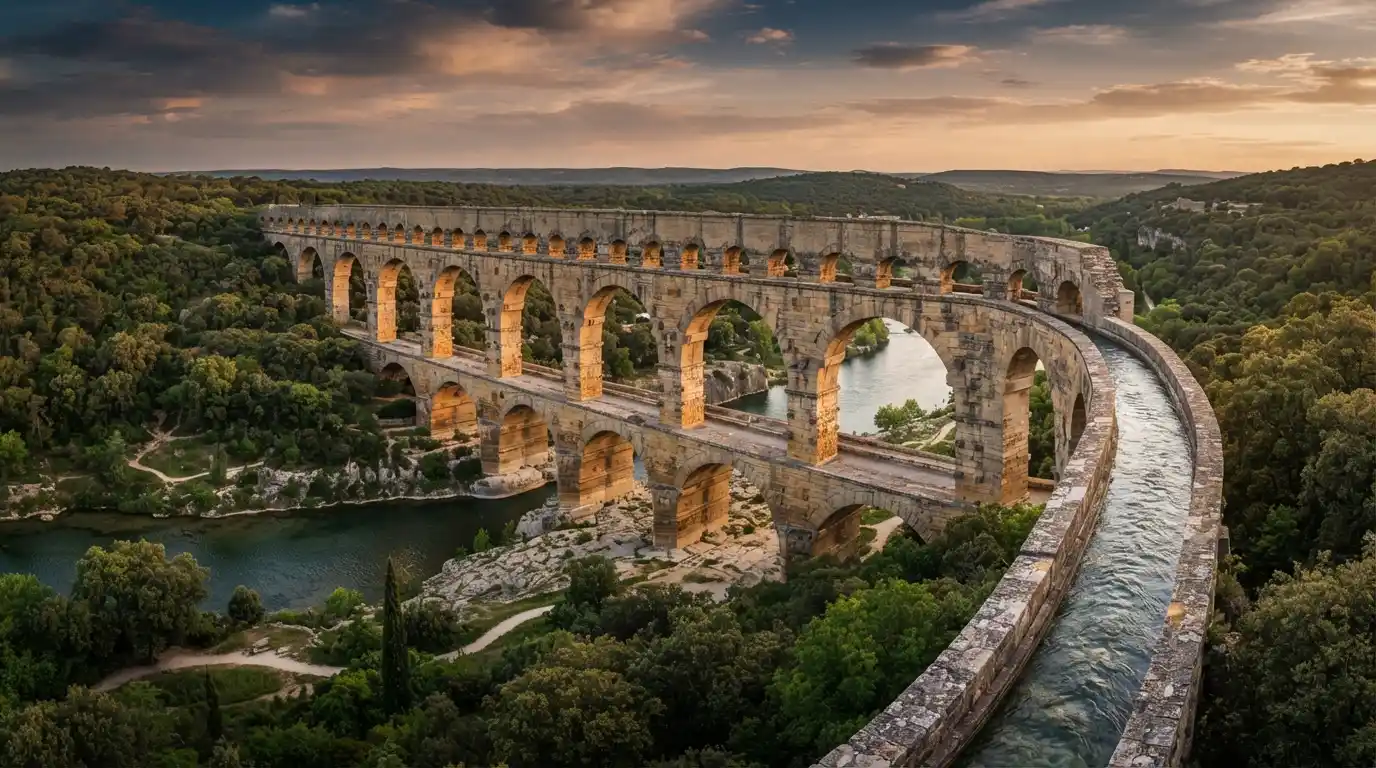
- Social Situations: Tourists admire the Roman Pont du Gard while discussing ancient architectural achievements.
- Media / Pop Culture: Documentaries highlight how vast California pipeline networks supply water to cities.
- Writing & Storytelling: A fantasy writer describes a rushing mill race powering a village blacksmith shop.
Interactive Practice Quiz
Test Your Knowledge
1. Which term specifically describes a bridge carrying water across a valley?
A) Culvert
B) Aqueduct bridge
C) Drain
D) Viaduct
2. What is the key difference between a viaduct and an aqueduct?
A) There is no structural difference.
B) Viaducts are underground; aqueducts are above ground.
C) Viaducts carry vehicles or trains; aqueducts carry water.
D) Viaducts carry electricity; aqueducts carry natural gas.
3. Which word carries a technical, civil engineering register?
A) Conduit
B) Gutter
C) Ditch
D) Runnel
4. What is the Latin root meaning of ducere in the word “aqueduct”?
A) To clean
B) To freeze
C) To lead or guide
D) To build
5. Select the best term for a tunnel carrying water under a highway:
A) Trough
B) Culvert
C) Leat
D) Viaduct
6. Which term describes a narrow channel dug specifically to direct water to a mill wheel?
A) Mill race
B) Pipeline
C) Storm drain
D) Canal
Vocabulary & Meaning
7. Why is “ditch” considered negative or informal compared to “aqueduct”?
A) It is grammatically incorrect.
B) It refers only to ocean water.
C) It implies a crude, muddy ground excavation rather than an engineered structure.
D) It is an ancient Latin slang word.
8. Which option is used primarily for vessel navigation rather than municipal water supply?
A) Penstock
B) Canal
C) Flume
D) Siphon
9. Choose the best fit: “Rainwater poured from the broken roof ______ during the storm.”
A) Gutter
B) Headrace
C) Viaduct
D) Aqueduct line
10. What is the primary prefix in “aqueduct”?
A) Sub-
B) Intra-
C) Aque-
D) Trans-
11. Which term carries an agricultural, practical register for holding livestock water?
A) Penstock
B) Trough
C) Conduit
D) Viaduct
12. An “inverted siphon” relies on what principle to move water over land barriers?
A) Solar energy
B) Wind force
C) Mechanical pumps
D) Fluid pressure and gravity
Practical Application
Application Task:
Write one short sentence using the word conduit to describe water moving through a modern building.
Answer Key
1: B | 2: C | 3: A | 4: C | 5: B | 6: A | 7: C | 8: B | 9: A | 10: C | 11: B | 12: D
Frequently Asked Questions
1. What is the most common synonym for aqueduct in everyday English?
The most common synonym for aqueduct in daily conversation is “waterway” or “canal.” While aqueduct sounds formal, canal refers to artificial channels carrying water across land, making it easily understood in casual speech and news reports.
2. Is a viaduct the same thing as an aqueduct?
No, a viaduct and an aqueduct serve different transport purposes. An aqueduct is designed specifically to transport water across distances, whereas a viaduct supports a road, highway, or railway track across valleys or low points.
3. Can “conduit” be used as a synonym for aqueduct in formal writing?
Yes, conduit works well as a formal or technical synonym for aqueduct. It describes any pipe, tube, or channel through which fluids move, making it suitable for engineering reports, environmental essays, and academic papers.
4. What is a historical word for a small mill aqueduct?
In historical contexts, a small water channel feeding a mill is called a “leat” or a “mill race.” These regional terms describe synthetic ditches constructed specifically to direct river water toward water wheels.
5. Why do engineers differentiate between culverts and aqueducts?
Engineers differentiate them because a culvert is a short tunnel carrying water underneath roads or railways, while an aqueduct refers to a larger, extensive transport system carrying water across long distances above or across ground.
Conclusion
Mastering a versatile synonym for aqueduct helps you describe civil achievements, agricultural channels, and natural waterways with clarity. Furthermore, expanding your engineering vocabulary enriches your descriptive writing, academic work, and professional reports.
When you select an exact synonym for aqueduct, your sentences gain distinct visual power and professional precision. Moving past basic words gives your daily English expression an impressive, highly effective upgrade.
We encourage you to practice using a new synonym for aqueduct in your next project, article, or essay. Consistent daily practice ensures that dynamic vocabulary choices become second nature over time.

Sawera Rani is the founder and content creator behind VocabularyFinder.com, a platform designed to help learners improve their English vocabulary simply and effectively. With a passion for language learning, Sawera Rani creates easy-to-understand vocabulary guides, word meanings, definitions, and practical examples that make learning new words easier. She aims to provide useful and reliable resources for students, professionals, and English learners who want to improve their communication skills. Through VocabularyFinder.com, she focuses on making vocabulary learning more accessible, engaging, and helpful for everyday use.