
Synonym for apparition choices allow you to describe mysterious sightings, spectral figures, and unusual visions with vibrant precision and accuracy.
Imagine walking through a foggy park at dusk and spotting a pale shadow that vanishes into thin air. Using a tailored synonym for apparition captures that exact chill.
Learning a rich synonym for apparition expands your descriptive power significantly. Consequently, students, bloggers, and storytellers can create vivid imagery easily.
Mastering these descriptive terms helps writers paint detailed pictures without repeating basic terms. Furthermore, everyday English speakers gain deeper vocabulary confidence.
What Does “Apparition” Really Mean?
The word “apparition” describes a remarkable or unexpected sight, especially a ghostly figure or a sudden visual illusion that catches you off guard. Native speakers use it when referring to supernatural sightings, mysterious figures, or sudden visual manifestations. Therefore, you will often find it in literature, folklore, and descriptive storytelling.
Part of Speech: Noun
Definition: A ghost or ghostlike image of a person; a sudden or unusual sight that appears unexpectedly.
Connotative Meaning
Words carry distinct emotional associations that influence how your audience interprets your message. (Connotation means the emotional association or cultural feeling a word carries beyond its explicit definition).
- Positive Tone: Signals a divine revelation, a miraculous vision, or a comforting spiritual presence.
- Negative Tone: Suggests a terrifying ghost, a eerie phantom, or a unsettling omen.
- Neutral Tone: Functions purely as an objective description of an unusual visual phenomenon or illusion.
Etymology
The noun “apparition” originated in Latin through Old French before entering the English language during the late Middle Ages.
- Old English (450–1100): Early speakers used native Germanic terms like gāst (spirit) long before Latin imports arrived.
- Middle English (1100–1500): Borrowed from Anglo-French aparicion, originating from Latin apparitio (attendance or appearance).
- Modern English (1500–Present): Evolved into its primary modern sense of a supernatural ghost or unexpected visual manifestation.
Pronunciation (US & UK)
- US: /ˌæp.əˈrɪʃ.ən/
- UK: /ˌæp.əˈrɪʃ.ən/
Syllables
ap-pa-ri-tion
Affixation Pattern
- Root: appear (from Latin apparere)
- Prefix: None
- Suffix: -ition (noun-forming suffix denoting a state, action, or process)
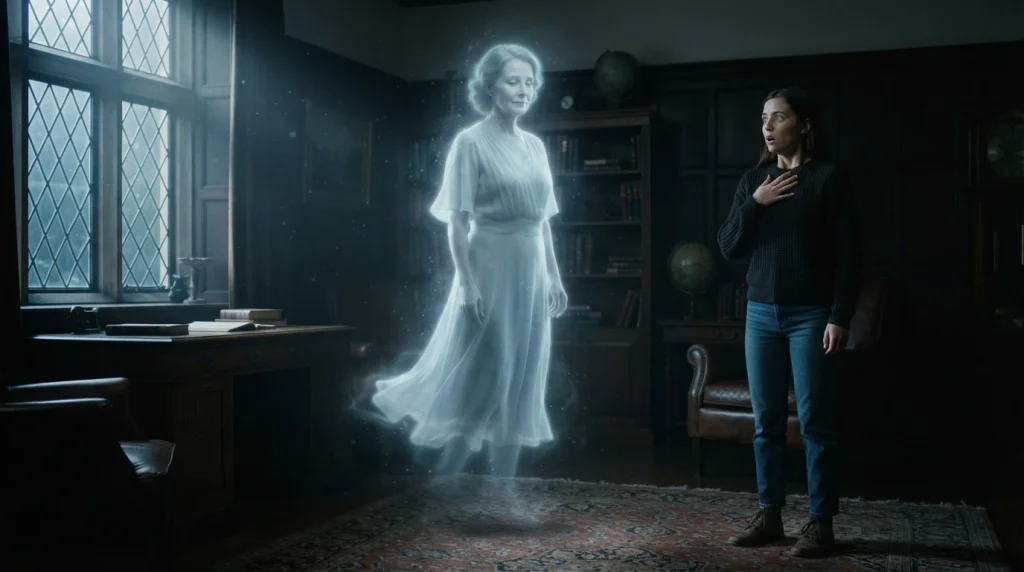
Synonyms List
Ghost (Noun) — US: /ɡoʊst/ | UK: /ɡəʊst/
Meaning: The disembodied spirit of a deceased person that appears to the living.
Tone/Register: General, Common.
Examples: The old lighthouse was famous for its resident ghost. Local residents claimed to see it pacing the balcony at midnight.
Phantom (Noun) — US: /ˈfæn.təm/ | UK: /ˈfæn.təm/
Meaning: A figment of the imagination or a ghostly figure without physical substance.
Tone/Register: Literary, Dramatic.
Examples: A pale phantom slipped through the trees during the heavy mist. The mysterious shape vanished as soon as the torch swept across.
Specter (Noun) — US: /ˈspek.tɚ/ | UK: /ˈspek.tər/
Meaning: A haunting spirit or a terrifying threat that lingers in the mind.
Tone/Register: Formal, Literary.
Examples: The dark specter stood quietly at the top of the stairwell. Furthermore, the looming threat of inflation spooked investors across the nation.
Spirit (Noun) — US: /ˈspɪr.ət/ | UK: /ˈspɪr.ɪt/
Meaning: An invisible supernatural force or the conscious soul of a departed individual.
Tone/Register: Neutral, Spiritual.
Examples: The tribal elders spoke softly to honor the ancient mountain spirit. They believed the friendly presence guarded their peaceful valley.
Shade (Noun) — US: /ʃeɪd/ | UK: /ʃeɪd/
Meaning: The lingering shadow or spirit of a dead person dwelling in darkness.
Tone/Register: Archaic, Poetic.
Examples: Poets wrote about the sad shade haunting the ancient ruins. The figure sat quietly near the forgotten stone monument.
Wraith (Noun) — US: /reɪθ/ | UK: /reɪθ/
Meaning: A faint, shadowy apparition of a person seen shortly before or after death.
Tone/Register: Literary, Fantasy.
Examples: A slender wraith emerged from the dense river fog at dawn. The shadowy figure glided silently across the damp grass.
Vision (Noun) — US: /ˈvɪʒ.ən/ | UK: /ˈvɪʒ.ən/
Meaning: A vivid visual experience of a supernatural force or a mental image.
Tone/Register: Positive, Spiritual, Formal.
Example: The traveler experienced a bright vision while resting near the shrine. The radiant image filled the small cave with warm light.
Illusion (Noun) — US: /ɪˈluː.ʒən/ | UK: /ɪˈluː.ʒən/
Meaning: A deceptive appearance or a misinterpretation of real sensory information.
Tone/Register: Scientific, Neutral.
Examples: The shimmering pool of water on the hot road was a desert illusion. Consequently, the thirsty travelers were disappointed when they arrived.
Phantasm (Noun) — US: /ˈfæn.tæz.əm/ | UK: /ˈfæn.tæz.əm/
Meaning: An illusory mental image or a ghostlike entity created by the mind.
Tone/Register: Academic, Formal.
Examples: His fever caused him to see strange phantasms on the bedroom wall. The dark shapes danced rhythmically until morning came.
Presence (Noun) — US: /ˈprez.əns/ | UK: /ˈprez.əns/
Meaning: An unseen spiritual being or an unmistakable feeling of someone nearby.
Tone/Register: General, Descriptive.
Examples: She felt a cold presence standing right behind her in the dark room. However, nobody appeared when she turned on the overhead lamp.
Materialization (Noun) — US: /məˌtɪr.i.ə.ləˈzeɪ.ʃən/ | UK: /məˌtɪə.ri.ə.laɪˈzeɪ.ʃən/
Meaning: The act of taking a tangible or visible physical form suddenly.
Tone/Register: Technical, Paranormal.
Examples: The sudden materialization of the mysterious figure stunned the scientists. The cameras captured every second of the strange event.
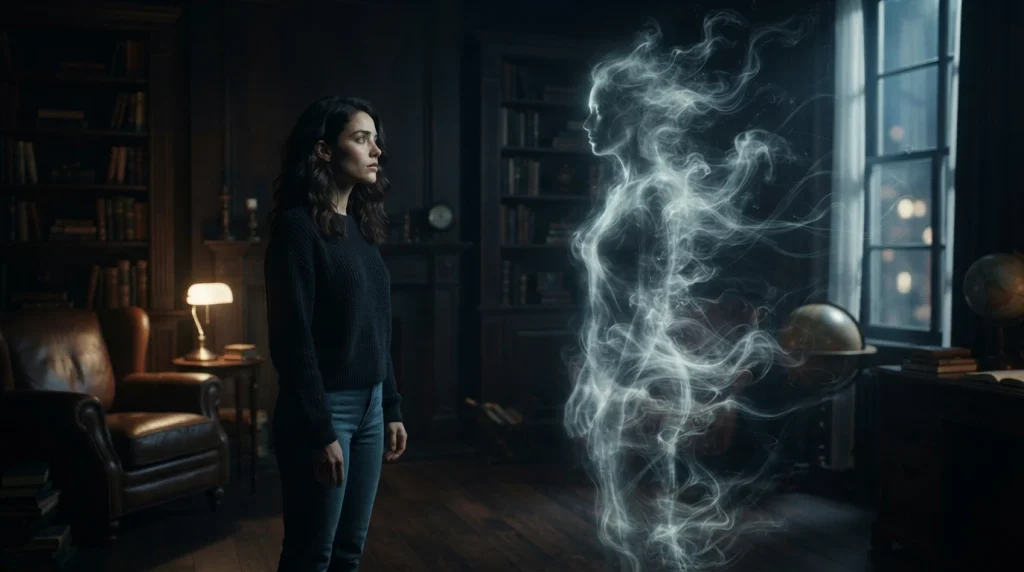
Manifestation (Noun) — US: /ˌmæn.ə.fesˈteɪ.ʃən/ | UK: /ˌmæn.ɪ.fesˈteɪ.ʃən/
Meaning: An event, action, or object that clearly shows or embodies an abstract idea or spirit.
Tone/Register: Formal, Academic.
Examples: The glowing orb was considered a physical manifestation of energy. Researchers documented the unusual event carefully.
Image (Noun) — US: /ˈɪm.ɪdʒ/ | UK: /ˈɪm.ɪdʒ/
Meaning: A visual representation, reflection, or shadowy likeness of a person or object.
Tone/Register: General, Neutral.
Examples: A faint image of the old king appeared in the stained glass window. Visitors gathered quietly to catch a glimpse of the reflection.
Phenomenon (Noun) — US: /fəˈnɑː.mə.nɑːn/ | UK: /fəˈnɒm.ɪ.nən/
Meaning: A remarkable event or situation that is observed, particularly one whose cause is in question.
Tone/Register: Scientific, Formal.
Examples: The strange green light over the valley remains an unexplained phenomenon. Scientists arrive every summer to study the atmospheric conditions.
Mirage (Noun) — US: /mɪˈrɑːʒ/ | UK: /mɪˈrɑːʒ/
Meaning: An optical illusion caused by atmospheric conditions, especially the appearance of a sheet of water.
Tone/Register: General, Descriptive.
Examples: The distant oasis turned out to be a mere mirage created by heat rays. Therefore, the expedition continued searching for real water sources.
Chimera (Noun) — US: /kaɪˈmɪr.ə/ | UK: /kaɪˈmɪə.rə/
Meaning: A foolish or impossible fantasy, or a mythical monster made of diverse parts.
Tone/Register: Literary, Formal.
Examples: Hoping for a quick solution proved to be a total chimera. Instead, the team had to work diligently for many months.
Spook (Noun) — US: /spuːk/ | UK: /spuːk/
Meaning: An informal or lighthearted term for a ghost or eerie spirit.
Tone/Register: Informal, Casual.
Examples: The kids giggled as they hunted for a spook in the attic. They searched behind old wooden trunks with bright flashlights.
Revenant (Noun) — US: /ˈrev.ə.nənt/ | UK: /ˈrev.ə.nənt/
Meaning: A person who has returned, especially supposedly from the dead as a spirit.
Tone/Register: Literary, Historical.
Examples: Ancient legends warned villagers about the fierce revenant wandering the bog. The tale kept children safe inside after darkness fell.
Shadow (Noun) — US: /ˈʃæd.oʊ/ | UK: /ˈʃæd.əʊ/
Meaning: A dark shape produced by an object blocking light, or a mysterious lingering figure.
Tone/Register: General, Visual.
Examples: A tall shadow glided silently along the alley wall. It disappeared as soon as the streetlamp flickered on.
Poltergeist (Noun) — US: /ˈpoʊl.tɚ.ɡaɪst/ | UK: /ˈpɒl.tə.ɡaɪst/
Meaning: A noisy spirit believed to create physical disturbances like moving objects.
Tone/Register: Specialized, Paranormal.
Examples: The family blamed the poltergeist when dishes shattered in the kitchen. Consequently, they called an expert to inspect their haunted residence.
Entity (Noun) — US: /ˈen.t̬ə.t̬i/ | UK: /ˈen.tɪ.ti/
Meaning: A thing with distinct and independent existence, often used for unknown spirits.
Tone/Register: Technical, Neutral.
Example: The paranormal team detected an unknown entity in the basement. Their sensors recorded temperature drops near the old door.
Banshee (Noun) — US: /ˈbæn.ʃiː/ | UK: /ˈbæn.ʃiː/
Meaning: A female spirit in Irish folklore whose wailing warns of a death in a family.
Tone/Register: Cultural, Mythological.
Examples: The chilling cry sounded like a banshee wailing in the night storm. Villagers pulled their blankets tight until morning light returned.
Astral Body (Noun) — US: /ˈæs.trəl ˈbɑː.di/ | UK: /ˈæs.trəl ˈbɒd.i/
Meaning: A subtle spiritual counterpart to the physical body in esoteric beliefs.
Tone/Register: Esoteric, Specialized.
Examples: The monk described projecting his astral body across great distances. He shared his meditation practice with eager students.
Eidolon (Noun) — US: /aɪˈdoʊ.lən/ | UK: /aɪˈdəʊ.lən/
Meaning: An idealized person, or a ghostly image or phantom from classical literature.
Tone/Register: Archaic, Literary.
Examples: Greek tales describe the hero meeting an eidolon of his former friend. The spectral form spoke softly about old battles.
Haunt (Noun) — US: /hɑːnt/ | UK: /hɔːnt/
Meaning: A ghost or spirit that frequents a particular location.
Tone/Register: Informal, Regional.
Examples: The locals called the ruined castle the haunt of ancient knights. Visitors explored the ivy-covered stone walls with curiosity.
Visitant (Noun) — US: /ˈvɪz.ɪ.tənt/ | UK: /ˈvɪz.ɪ.tənt/
Meaning: A visitor from another world, especially a ghost or spiritual messenger.
Tone/Register: Formal, Historical.
Example: The old manuscript described a heavenly visitant clad in glowing robes. The monks recorded the event in their official monastery records.
Spiritus (Noun) — US: /ˈspɪr.ɪ.təs/ | UK: /ˈspɪr.ɪ.təs/
Meaning: A breath of life or a divine spiritual force from Latin tradition.
Tone/Register: Academic, Historical.
Examples: Philosophers studied the concept of spiritus during medieval times. They debated how breath connected to the human soul.
Double (Noun) — US: /ˈdʌb.əl/ | UK: /ˈdʌb.əl/
Meaning: A ghostly counterpart or exact living duplicate of a person.
Tone/Register: General, Storytelling.
Examples: He gasped when he saw his exact double standing across the street. The mysterious lookalike turned around and blended into the crowd.
Doppelganger (Noun) — US: /ˈdɑː.pəlˌɡæŋ.ɚ/ | UK: /ˈdɒp.əlˌɡæŋ.ər/
Meaning: A biological or ghostly twin or double of a living person.
Tone/Register: General, Cultural.
Examples: Meeting your doppelganger is often considered a spooky omen in folklore. She smiled when her friend pointed out her striking double.
Spectral Form (Noun) — US: /ˈspek.trəl fɔːrm/ | UK: /ˈspek.trəl fɔːm/
Meaning: The visible outline or translucent shape of a ghost.
Tone/Register: Descriptive, Literary.
Examples: A spectral form hovered silently above the altar inside the cathedral. The soft glow illuminated the dusty pews below.
Visual Illusion (Noun) — US: /ˈvɪʒ.u.əl ɪˈluː.ʒən/ | UK: /ˈvɪʒ.u.əl ɪˈluː.ʒən/
Meaning: A misinterpretation of real visual data by the human eye or brain.
Tone/Register: Scientific, Psychological.
Examples: The flickering candlelight created a visual illusion on the wall. Therefore, the room seemed much larger than it actually was.
Optical Delusion (Noun) — US: /ˈɑːp.tɪ.kəl dɪˈluː.ʒən/ | UK: /ˈɒp.tɪ.kəl dɪˈluː.ʒən/
Meaning: A false mental perception caused by distorted visual signals.
Tone/Register: Academic, Formal.
Examples: The doctor explained that the dark shape was an optical delusion. Lack of sleep had exhausted the patient’s eyes.
Hallucination (Noun) — US: /həˌluː.səˈneɪ.ʃən/ | UK: /həˌluː.sɪˈneɪ.ʃən/
Meaning: A perception of an object or figure with no reality, caused by illness or drugs.
Tone/Register: Medical, Clinical.
Examples: High fever caused the patient to experience a strange hallucination. She thought bright butterflies were flying around her room.
Revelation (Noun) — US: /ˌrev.əˈleɪ.ʃən/ | UK: /ˌrev.əˈleɪ.ʃən/
Meaning: A dramatic or divine disclosure of truth or a heavenly vision.
Tone/Register: Spiritual, Formal.
Example: The hermit experienced a profound revelation on the peaceful hilltop. He shared his message of harmony with the nearby town.
Epiphany (Noun) — US: ɪˈpɪf.ə.ni | UK: ɪˈpɪf.ə.ni
Meaning: A moment of sudden and great revelation or spiritual realization.
Tone/Register: Formal, Literary.
Examples: A sudden epiphany struck her while observing the starry night sky. She realized the solution to her complex project instantly.
Bogle (Noun) — US: /ˈboʊ.ɡəl/ | UK: /ˈbəʊ.ɡəl/
Meaning: A folklore phantom or ghost causing fright in Scottish dialect.
Tone/Register: Dialectal, Historical.
Examples: Old tales warned travelers about the bogle haunting the misty glen. Walkers picked up their pace whenever dusk arrived.

Fetch (Noun) — US: /fetʃ/ | UK: /fetʃ/
Meaning: A supernatural double of a living person whose appearance portends death.
Tone/Register: Regional, Mythological.
Examples: In Irish lore, seeing a person’s fetch in the morning brings good luck. However, seeing it at night signals impending trouble.
Supernatural Sight (Noun) — US: /ˌsuː.pɚˈnætʃ.ɚ.əl saɪt/ | UK: /ˌsuː.pəˈnætʃ.ər.əl saɪt/
Meaning: A visual event that defies natural laws or physical explanations.
Tone/Register: Descriptive, General.
Examples: The glowing fog was a supernatural sight that dazzled the tourists. Everyone took photographs of the shimmering lake surface.
Unearthly Being (Noun) — US: /ʌnˈɝːθ.li ˈbiː.ɪŋ/ | UK: /ʌnˈɜːθ.li ˈbiː.ɪŋ/
Meaning: A creature or spirit that clearly does not originate from the material world.
Tone/Register: Expressive, Fantasy.
Examples: The story featured an unearthly being that guarded ancient secrets. It tested every knight who approached the castle gate.
Spectral Image (Noun) — US: /ˈspek.trəl ˈɪm.ɪdʒ/ | UK: /ˈspek.trəl ˈɪm.ɪdʒ/
Meaning: A ghostlike or translucent visual reflection.
Tone/Register: Descriptive, Technical.
Examples: The camera picked up a spectral image near the wooden window frame. Photographers analyzed the digital film for reflections.

Synonyms for by Tone
Positive
- Vision: Suggests a divine, beautiful, or inspiring spiritual sight.
- Revelation: Highlights a meaningful or uplifting spiritual insight.
- Epiphany: Reflects an enlightening moment of sudden mental clarity.
Neutral
- Phenomenon: Describes an unusual event objectively without supernatural bias.
- Illusion: Focuses on sensory perception rather than spooky spirits.
- Presence: Neutral term for feeling or seeing an entity nearby.
- Manifestation: Technical word describing energy taking physical shape.
Negative
- Specter: Evokes dread, lingering danger, or unsettling threats.
- Wraith: Suggests a terrifying, deathly spirit emerging from darkness.
- Poltergeist: Implies a chaotic, noisy, and destructive presence.
- Banshee: Associated with mournful wailing and impending misfortune.
Playful/Informal
- Spook: Casual term used in lighthearted ghost stories or halloween fun.
- Haunt: Informal way to describe a localized spirit or favorite spot.
- Doppelganger: Fun, modern term for spotting a living twin on the street.
Selecting the right tone prevents stylistic errors. For example, using spook in a scientific paper about visual optics creates an awkward tone conflict.
“Apparition” vs. Close Alternatives
| Term | Core Focus | Tone | Best Usage Scenario |
| Apparition | Sudden visual sighting of a spirit or mystery | Literary, Formal | Dramatic storytelling, folklore, classical essays |
| Ghost | Disembodied spirit of a deceased person | General, Common | Casual speech, everyday horror stories, general chat |
| Phantom | Imaginary or elusive figure without physical substance | Dramatic, Poetic | Atmospheric fiction, poetry, expressive prose |
How “Apparition” Changes by Context
Daily Conversation
In casual settings, people rarely say apparition. Instead, native speakers use everyday words like ghost or spook. For example, “I thought I saw a ghost in the hallway.”
Writing or Blogging
Bloggers and content writers use phantom, presence, or vision to add sensory texture. This variety keeps readers engaged without relying on repetitive vocabulary.
Professional or Academic Tone
Scientific reports or medical essays avoid supernatural terms entirely. Researchers select visual illusion, phenomenon, or hallucination to maintain objectivity.
Creative or Informal Use
Fantasy and horror writers rely heavily on rich alternatives like wraith, specter, or doppelganger. Consequently, these choices build suspense and establish an eerie atmosphere.

Common Mistakes & Native Usage
- Calling any illusion an apparition: An apparition specifically involves a distinct figure or appearance, whereas a mirage refers to environmental distortions like heat shimmer.
- Overusing “apparition” in casual conversation: Using apparition during everyday chat can sound stiff or overly dramatic; choose ghost instead.
- Confusing “illusion” with “hallucination”: An illusion distorts real external stimuli, while a hallucination occurs entirely within the mind without external triggers.
(Looking to polish your vocabulary skills further? Check out our complete guide on modern writing techniques).
Real-Life Mini Scenarios
- Workplace: A designer describes a flickering screen glitch as a visual illusion caused by lighting.
- Social Situations: Friends share fun ghost stories around a campfire using terms like spook and shadow.
- Media / Pop Culture: Movies depict a glowing specter haunting ancient ruins to build suspense.
- Writing & Storytelling: A novelist describes a wraith emerging from river fog to set a eerie scene.
Interactive Practice Quiz
1. Which synonym best suits a scientific report analyzing sensory errors?
A) Wraith
B) Visual illusion
C) Banshee
D) Spook
2. Which word carries a positive, inspiring spiritual tone?
A) Specter
B) Vision
C) Poltergeist
D) Revenant
3. What is the root origin of the word “apparition”?
A) Greek phos
B) Latin apparere
C) Old Norse gastr
D) Celtic banshee
4. Which option describes a living person’s exact double or twin?
A) Doppelganger
B) Mirage
C) Poltergeist
D) Epiphany
5. Select the informal, lighthearted word for a ghost.
A) Phantasm
B) Materialization
C) Spook
D) Eidolon
6. Which term implies a noisy spirit that moves physical objects?
A) Shade
B) Poltergeist
C) Mirage
D) Fetch
7. Why is “apparition” rarely used in daily conversation?
A) It is grammatically incorrect.
B) It has a formal, literary tone.
C) It has no clear definition.
D) It is an ancient slang word.
8. Which word describes a sudden, profound realization or disclosure?
A) Epiphany
B) Wraith
C) Shadow
D) Doppelganger
9. Choose the best fit: “The heat produced a shimmering _____ on the desert highway.”
A) Banshee
B) Mirage
C) Poltergeist
D) Wraith
10. What prefix is present in the word “apparition”?
A) Dis-
B) Un-
C) None
D) Pre-
11. Which term carries a strong medical or clinical register?
A) Hallucination
B) Shade
C) Bogle
D) Spook
12. “Specter” is most commonly used to describe:
A) A cheerful feeling
B) A haunting spirit or lingering threat
C) A scientific tool
D) A bright sunny day
Application Task
Write one short sentence using the word phantom to describe a scene in a story.
1: B | 2: D | 3: A | 4: C | 5: B | 6: A | 7: D | 8: C | 9: A | 10: D | 11: B | 12: C
Frequently Asked Questions
1. What is the most common synonym for apparition in everyday English?
The most common synonym for apparition in daily English is “ghost.” While apparition carries a literary tone, ghost is universally understood across all casual conversations, movies, and everyday contexts. Other common choices include “spirit” or “phantom.”
2. How does an apparition differ from a hallucination?
An apparition refers to a mysterious figure or ghostlike sight, often within storytelling or folklore. Conversely, a hallucination is a clinical medical term for a sensory experience created entirely by the brain due to fever, illness, or fatigue.
3. Can “apparition” describe something that is not a ghost?
Yes, an apparition can describe any sudden, unexpected, or remarkable visual sighting, such as an unusual astronomical event or optical effect. However, native speakers primarily associate the term with supernatural or ghostly figures in descriptive writing.
4. What is a good academic alternative for apparition?
In academic or scientific writing, replace apparition with objective terms like “visual illusion,” “unexplained phenomenon,” or “sensory distortion.” These choices maintain a professional, analytical tone suitable for research papers and formal essays.
5. Why is “doppelganger” listed as a synonym for apparition?
A doppelganger is a ghostly double or exact living duplicate of a person, fitting the broader definition of an unexpected spectral manifestation. Both terms describe mysterious visual appearances that startle the observer in stories and folklore.
Conclusion
Mastering a versatile synonym for apparition allows you to describe mysterious events, spectral sights, and optical illusions with precision. Furthermore, expanding your vocabulary enhances your descriptive writing, communication skills, and creative confidence across every project.
When you select a fitting synonym for apparition, your prose becomes significantly more engaging and evocative for readers. Moving past basic words gives your daily English expression a powerful, noticeable boost.
We encourage you to practice using a new synonym for apparition in your next essay, story, or conversation. Consistent practice ensures that dynamic, expressive communication becomes second nature over time.

Sawera Rani is the founder and content creator behind VocabularyFinder.com, a platform designed to help learners improve their English vocabulary simply and effectively. With a passion for language learning, Sawera Rani creates easy-to-understand vocabulary guides, word meanings, definitions, and practical examples that make learning new words easier. She aims to provide useful and reliable resources for students, professionals, and English learners who want to improve their communication skills. Through VocabularyFinder.com, she focuses on making vocabulary learning more accessible, engaging, and helpful for everyday use.