
A synonym for cosmic includes terms like celestial, astronomical, universal, galactic, stellar, or infinite, depending on whether the context refers to deep space, scientific phenomena, or vast scale. Common choices range from scientific adjectives like interstellar to poetic descriptors like otherworldly.
A synonym for cosmic helps you describe outer space and vast ideas without relying on repetitive words. Imagine staring up at a clear desert night sky filled with millions of sparkling stars. Describing that view as a celestial display feels far more evocative than simply calling it big.
Using a precise synonym for cosmic refines your descriptive skills across essays, fiction, and science articles. For instance, describing a major coincidence as a moment of universal alignment adds grandeur to your narrative.
Finding a versatile synonym for cosmic empowers students, bloggers, fiction writers, and science communicators. Expanding your descriptive vocabulary ensures your writing remains vivid, engaging, and precise across all topics.
What Does “Cosmic” Really Mean?
Cosmic describes anything relating to the universe, outer space, or vast systems existing beyond Earth’s atmosphere.
In English, it functions primarily as an adjective (cosmic dust) to describe astronomical phenomena or immense scale.
Part of Speech: Adjective
Definition: Relating to the universe or outer space, or existing on an extraordinarily vast scale.
Connotative Meaning
(Connotation is the emotional feeling or cultural association that a word carries beyond its literal dictionary definition.)
- Positive tone: Inspires awe, wonder, majestic beauty, and deep intellectual curiosity.
- Negative tone: Implies overwhelming insignificance, existential dread, or chaotic destruction (e.g., cosmic disaster).
- Neutral tone: Simply describes physical astronomical features, space radiation, or physical laws.
Etymology and Syllables
The word derives from the Ancient Greek kosmikos, from kosmos, meaning “order,” “harmony,” or “the world.”
- Old English (450–1100): No direct adjective existed; early writers used native terms like heofonlic (heavenly).
- Middle English (1100–1500): Latin scholars used cosmIcus in scientific treatises discussing world order.
- Modern English (1500–Present): Adopted into popular English during the 17th century as astronomy expanded.
Pronunciation (IPA):
- US: /ˈkɑːz.mɪk/
- UK: /ˈkɒz.mɪk/
Syllables: cos-mic
- Root: Cosm (from Greek kosmos, meaning order or universe)
- Prefix: None
- Suffix: -ic (adjective suffix meaning relating to)
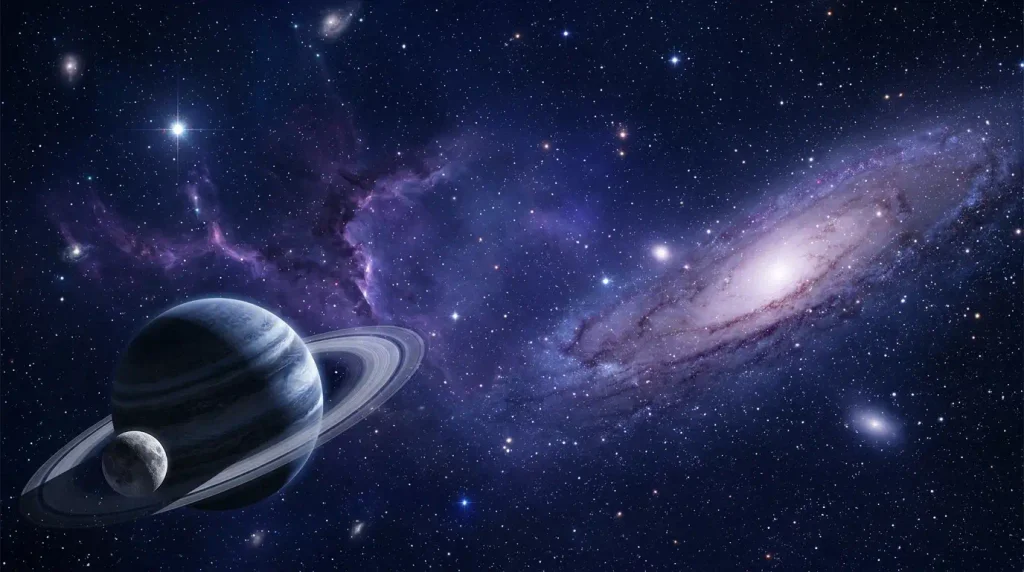
Comprehensive List of 45 Synonyms
Celestial (Adjective) — US: /səˈles.tʃəl/ | UK: /səˈles.ti.əl/
Meaning: Relating to the sky or outer space as observed in astronomy.
Tone/Register: Formal, Poetic, Astronomical
Examples:
Astronomers recorded the movement of several celestial bodies across the night sky.
She admired the celestial beauty of the glowing nebula through the telescope.
Astronomical (Adjective) — US: /ˌæs.trəˈnɑː.mɪ.kəl/ | UK: /ˌæs.trəˈnɒm.ɪ.kəl/
Meaning: Relating to astronomy, or extremely large in magnitude or scale.
Tone/Register: Scientific, Formal, High Scale
Examples:
The university constructed a new observatory for astronomical research.
The project ran into astronomical costs before completion.
Universal (Adjective) — US: /ˌjuː.nəˈvɝː.səl/ | UK: /ˌjuː.nɪˈvɜː.səl/
Meaning: Relating to or existing throughout the entire universe or all creation.
Tone/Register: Academic, Philosophical
Examples:
Gravity acts as a universal force affecting all physical matter.
Music is often described as a universal language across cultures.
Galactic (Adjective) — US: /ɡəˈlæk.tɪk/ | UK: /ɡəˈlæk.tɪk/
Meaning: Relating to a galaxy or the Milky Way system specifically.
Tone/Register: Scientific, Sci-Fi
Examples:
Sensors detected unusual energy emissions near the galactic core.
The sci-fi novel depicted an empire spanning entire galactic clusters.
Stellar (Adjective) — US: /ˈstel.ɚ/ | UK: /ˈstel.ər/
Meaning: Relating to stars, or outstandingly exceptional in performance.
Tone/Register: Scientific, Praise, General
Examples:
Scientists measured the chemical composition of stellar wind particles.
She delivered a stellar presentation that impressed the department head.
Interstellar (Adjective) — US: /ˌɪn.t̬ɚˈstel.ɚ/ | UK: /ˌɪn.təˈstel.ər/
Meaning: Existing or occurring in the vast spaces located between stars.
Tone/Register: Scientific, Specialized
Examples:
Probes collected rare data while traveling through interstellar space.
Dense clouds of interstellar gas slowly formed new solar systems.
Extraterrestrial (Adjective) — US: /ˌek.strə.təˈres.tri.əl/ | UK: /ˌek.strə.təˈres.tri.əl/
Meaning: Originating or existing beyond Earth or its surrounding atmosphere.
Tone/Register: Scientific, Sci-Fi
Examples:
Researchers searched deep space signals for evidence of extraterrestrial origin.
The museum displayed a meteorite confirmed to be of extraterrestrial material.
Heavenly (Adjective) — US: /ˈhev.ən.li/ | UK: /ˈhev.ən.li/
Meaning: Relating to the sky, space, or divine realm above Earth.
Tone/Register: Descriptive, General
Examples:
Ancient mariners navigated open oceans by observing heavenly bodies.
A warm breeze and blue skies made for a heavenly morning.
Space-age (Adjective) — US: /ˈspeɪs.eɪdʒ/ | UK: /ˈspeɪs.eɪdʒ/
Meaning: Characterized by advanced, modern technology reminiscent of space exploration.
Tone/Register: Informal, Modern
Examples:
The futuristic sports car featured a sleek, space-age dashboard design.
Engineers developed space-age fabrics designed for extreme temperatures.
Intergalactic (Adjective) — US: /ˌɪn.t̬ɚ.ɡəˈlæk.tɪk/ | UK: /ˌɪn.tə.ɡəˈlæk.tɪk/
Meaning: Occurring or situated between two or more distinct galaxies.
Tone/Register: Scientific, Sci-Fi
Examples:
Light from distant stars travels through vast intergalactic voids.
The research team mapped intergalactic dust streams using deep radar.
Planetary (Adjective) — US: /ˈplæn.ə.ter.i/ | UK: /ˈplæn.ɪ.tər.i/
Meaning: Relating to or belonging to planets and their orbital paths.
Tone/Register: Scientific, Environmental
Examples:
Volcanoes significantly altered the planet’s atmospheric evolution.
Protecting biodiversity is crucial for maintaining planetary health.
Solar (Adjective) — US: /ˈsoʊ.lɚ/ | UK: /ˈsəʊ.lər/
Meaning: Relating to or derived from the sun and its energy output.
Tone/Register: Technical, Environmental
Examples:
The house powers its electrical systems using rooftop solar panels.
Satellites monitored intense solar flares during the storm.
Astral (Adjective) — US: /ˈæs.trəl/ | UK: /ˈæs.trəl/
Meaning: Connected with or resembling the stars or spiritual starlight realms.
Tone/Register: Literary, Esoteric
Examples:
The poet wrote verses praising the cold beauty of astral light.
Mystics studied ancient maps depicting astral projections.
Sidereal (Adjective) — US: /saɪˈdɪr.i.əl/ | UK: /saɪˈdɪə.ri.əl/
Meaning: Determined by or measured in relation to the apparent motion of stars.
Tone/Register: Specialized, Astronomical
Examples:
Astronomers use a sidereal day to track precise star positions.
Clocks at the observatory were set to sidereal time.
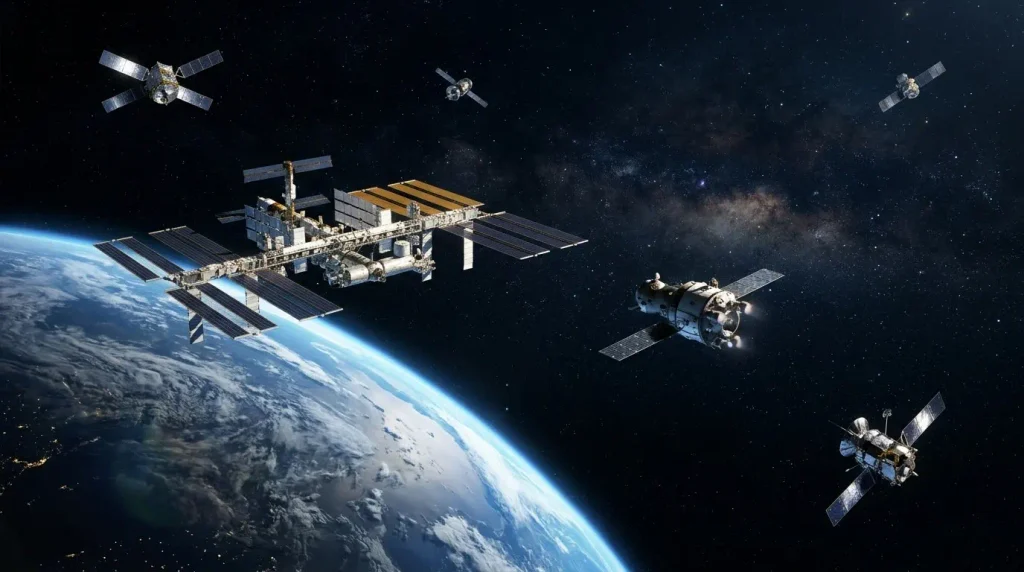
Outer-space (Adjective) — US: /ˌaʊ.t̬ɚˈspeɪs/ | UK: /ˌaʊ.təˈspeɪs/
Meaning: Situated in or originating from regions beyond Earth’s atmosphere.
Tone/Register: General, Casual
Examples:
Astronauts completed maintenance work during their outer-space walk.
Kids built model rockets for the school outer-space science fair.
Nebular (Adjective) — US: /ˈneb.jə.lɚ/ | UK: /ˈneb.jə.lər/
Meaning: Relating to or resembling a nebula, a giant cloud of gas and dust in space.
Tone/Register: Scientific, Descriptive
Examples:
Telescopes captured colorful images of nebular gas formations.
The nebular hypothesis explains the formation of our solar system.
Empyreal (Adjective) — US: /emˈpɪr.i.əl/ | UK: /emˈpɪr.i.əl/
Meaning: Relating to the highest heaven or sky, traditionally filled with pure light.
Tone/Register: High Literary, Poetic
Examples:
Poets wrote of empyreal heights beyond mortal human sight.
Golden sunlight washed over the mountain peaks in empyreal splendor.
Cosmic-scale (Adjective) — US: /ˈkɑːz.mɪk skeɪl/ | UK: /ˈkɒz.mɪk skeɪl/
Meaning: Measuring or operating on an unimaginably vast or universal dimension.
Tone/Register: Analytical, Epic
Examples:
The collision of galaxies represents an event on a cosmic-scale order.
Philosophers pondered human existence against cosmic-scale time spans.
Infinite (Adjective) — US: /ˈɪn.fə.nət/ | UK: /ˈɪn.fɪ.nət/
Meaning: Limitless or endless in space, extent, or size; impossible to measure.
Tone/Register: Philosophical, General
Examples:
Looking into deep space gives the sensation of endless, infinite reach.
Mathematically, parallel lines extend through infinite space.
Vast (Adjective) — US: /væst/ | UK: /vɑːst/
Meaning: Of immense extent, quantity, or size; immensely broad.
Tone/Register: Standard, Expressive
Examples:
A vast desert stretched across the horizon under the afternoon sun.
The ocean presents a vast expanse of dark water at night.
Boundless (Adjective) — US: /ˈbaʊnd.ləs/ | UK: /ˈbaʊnd.ləs/
Meaning: Having no boundaries, limits, or ending point.
Tone/Register: Expressive, Literary
Examples:
Her boundless enthusiasm inspired the entire project team.
Space offers a boundless frontier for future scientific exploration.
Immeasurable (Adjective) — US: /ɪˈmeʒ.ɚ.ə.bəl/ | UK: /ɪˈmeʒ.ər.ə.bəl/
Meaning: Too large, extensive, or deep to be measured accurately.
Tone/Register: Formal, Deep
Examples:
The ocean floor holds immeasurable natural resources.
Generous volunteers provided immeasurable assistance during the crisis.
Immense (Adjective) — US: /ɪˈmens/ | UK: /ɪˈmens/
Meaning: Extremely large or great, especially in scale or degree.
Tone/Register: Standard, Descriptive
Examples:
Constructing the bridge required an immense expenditure of effort.
An immense mountain range towered over the green valley below.
Colossal (Adjective) — US: /kəˈlɑː.səl/ | UK: /kəˈlɒs.əl/
Meaning: Enormously massive or structural in size and proportion.
Tone/Register: Expressive, Dramatic
Examples:
The museum features a colossal statue carved from solid granite.
A colossal wave crashed over the seawall during the storm.
Epic (Adjective) — US: /ˈep.ɪk/ | UK: /ˈep.ɪk/
Meaning: Impressive, heroic, or grand on a sweeping scale.
Tone/Register: Informal, Modern
Examples:
The director filmed an epic historical drama set in ancient Rome.
Their mountain journey became an epic adventure against the elements.
Monumental (Adjective) — US: /ˌmɑː.njəˈmen.t̬əl/ | UK: /ˌmɒn.jəˈmen.təl/
Meaning: Of outstanding significance, historical importance, or massive size.
Tone/Register: Formal, Academic
Examples:
Discovering penicillin was a monumental breakthrough for medicine.
The team faced a monumental task organizing the historic archives.
World-shattering (Adjective) — US: /wɝːld ˈʃæt̬.ɚ.ɪŋ/ | UK: /wɜːld ˈʃæt.ər.ɪŋ/
Meaning: Having an extremely intense, disruptive, or transformative global impact.
Tone/Register: Dramatic, Expressive
Examples:
News of the invention broke as a world-shattering announcement.
The discovery caused a world-shattering shift in economic strategy.
Tremendous (Adjective) — US: /trɪˈmen.dəs/ | UK: /trɪˈmen.dəs/
Meaning: Very great in amount, scale, or intensity.
Tone/Register: Everyday, General
Examples:
The charity event raised a tremendous sum for pediatric medical research.
He made tremendous progress recovering after his knee surgery.
Gigantic (Adjective) — US: /dʒaɪˈɡæn.t̬ɪk/ | UK: /dʒaɪˈɡæn.tɪk/
Meaning: Resembling a giant; exceptionally huge in physical size.
Tone/Register: Standard, Descriptive
Examples:
A gigantic cargo ship docked at the container port this morning.
Engineers built a gigantic turbine to capture offshore wind power.

Enormous (Adjective) — US: /əˈnɔːr.məs/ | UK: /ɪˈnɔː.məs/
Meaning: Marked by extraordinary size, extent, or degree.
Tone/Register: Neutral, Standard
Examples:
The mansion boasts an enormous garden with rare tropical plants.
Solving climate challenges requires an enormous international effort.
Unfathomable (Adjective) — US: /ʌnˈfæð.ə.mə.bəl/ | UK: /ʌnˈfæð.ə.mə.bəl/
Meaning: Incapable of being fully understood or measured due to extreme depth.
Tone/Register: Literary, Deep
Examples:
The deep ocean trench remains an unfathomable mystery to scientists.
She stared into space, overwhelmed by its unfathomable scale.
Otherworldly (Adjective) — US: /ˌʌð.ɚˈwɝːld.li/ | UK: /ˌʌð.əˈwɜːld.li/
Meaning: Seeming to belong to or originate from a world other than Earth.
Tone/Register: Descriptive, Creative
Examples:
The glowing northern lights gave the night landscape an otherworldly glow.
Mysterious, otherworldly sound effects played throughout the haunted attraction.
Ethereal (Adjective) — US: /iˈθɪr.i.əl/ | UK: /iˈθɪə.ri.əl/
Meaning: Extremely delicate, light, and heavenly in a way that seems unearthly.
Tone/Register: Artistic, Literary
Examples:
Morning mist created an ethereal atmosphere over the quiet lake.
The singer’s voice possessed an ethereal, haunting beauty.
Unearthly (Adjective) — US: /ʌnˈɝːθ.li/ | UK: /ʌnˈɜːθ.li/
Meaning: Mysterious, eerie, or unnatural; seemingly not belonging to Earth.
Tone/Register: Expressive, Dramatic
Examples:
An unearthly howl echoed through the dark forest at midnight.
Strange, unearthly lights hovered above the horizon before dawn.
Supramundane (Adjective) — US: /ˌsuː.prə.mʌnˈdeɪn/ | UK: /ˌsuː.prə.mʌnˈdeɪn/
Meaning: Existing or situated above or beyond the physical or earthly world.
Tone/Register: High Academic, Philosophical
Examples:
Philosophers debated the existence of supramundane reality.
The poem explores supramundane realms of thought and spirit.
Transcendental (Adjective) — US: /ˌtræn.senˈden.t̬əl/ | UK: /ˌtræn.senˈden.təl/
Meaning: Going beyond ordinary human experience or physical material limits.
Tone/Register: Philosophical, Formal
Examples:
Meditation provided her with a deeply transcendental sense of peace.
The composer sought to create music of transcendental brilliance.
Preternatural (Adjective) — US: /ˌpriː.t̬ɚˈnætʃ.ɚ.əl/ | UK: /ˌpriː.təˈnætʃ.ər.əl/
Meaning: Existing outside of extraordinary natural bounds; exceptional or strange.
Tone/Register: Formal, Literary
Examples:
The detective possessed a preternatural ability to notice tiny clues.
A preternatural silence settled over the valley before the storm hit.
Supernatural (Adjective) — US: /ˌsuː.pɚˈnætʃ.ɚ.əl/ | UK: /ˌsuː.pəˈnætʃ.ər.əl/
Meaning: Attributed to some force beyond scientific understanding or natural laws.
Tone/Register: General, Dramatic
Examples:
The novel tells the story of ghosts and supernatural phenomena.
Investigators found no evidence of supernatural activity in the home.
Mysterious (Adjective) — US: /mɪˈstɪr.i.əs/ | UK: /mɪˈstɪə.ri.əs/
Meaning: Difficult or impossible to understand, explain, or identify clearly.
Tone/Register: Everyday, General
Examples:
A mysterious package arrived at the office without a return address.
Scientists study mysterious radio bursts coming from deep space.
Deep-space (Adjective) — US: /diːp speɪs/ | UK: /diːp speɪs/
Meaning: Relating to regions of outer space far beyond the Earth-Moon system.
Tone/Register: Technical, Scientific
Examples:
NASA deployed new deep-space antennae to boost satellite communications.
The observatory specializes in tracking deep-space asteroids.
Cosmic-ray (Adjective) — US: /ˈkɑːz.mɪk reɪ/ | UK: /ˈkɒz.mɪk reɪ/
Meaning: Relating to high-energy atomic particles originating from outer space.
Tone/Register: Scientific, Physics
Examples:
Sensors detected a burst of cosmic-ray activity in upper atmosphere layers.
Spacecraft carry shielding to block harmful cosmic-ray exposure.
Abyss-like (Adjective) — US: /əˈbɪs laɪk/ | UK: /əˈbɪs laɪk/
Meaning: Resembling an immeasurably deep or bottomless chasm or void.
Tone/Register: Descriptive, Dramatic
Examples:
The ocean trench plunged into abyss-like darkness far below the surface.
Staring into the void produced an abyss-like sensation of depth.
Starlight (Adjective) — US: /ˈstɑːr.laɪt/ | UK: /ˈstɑː.laɪt/
Meaning: Illuminated by or derived from the dim light of distant stars.
Tone/Register: Poetic, Descriptive
Examples:
They walked along the quiet beach beneath a clear starlight canopy.
The landscape took on a soft, starlight radiance in the late evening.
Skyward (Adjective) — US: /ˈskaɪ.wɚd/ | UK: /ˈskaɪ.wəd/
Meaning: Directed, pointing, or extending up toward the sky or cosmos.
Tone/Register: General, Directional
Examples:
The telescope pointed skyward to track the passing comet.
Tall skyscrapers thrust skyward above the city center.

Worldly-transcending (Adjective) — US: /ˈwɝːld.Li trænˈsen.dɪŋ/ | UK: /ˈwɜːld.Li trænˈsen.dɪŋ/
Meaning: Rising above mundane, physical, or earthly limitations completely.
Tone/Register: Expressive, Philosophical
Examples:
The artwork achieved a worldly-transcending impact on museum visitors.
His writings reflected a worldly-transcending focus on timeless truths.
Synonyms by Tone
Tone plays an essential role when selecting descriptive vocabulary. Choosing standard words ensures your prose remains clear, engaging, and authoritative. For authoritative background on space science terminology and definitions, consult trusted resources like NASA’s educational guides.
- Positive / Majestic: Celestial, Heavenly, Ethereal, Transcendental, Stellar, Empyreal.
- Neutral / Scientific: Astronomical, Galactic, Interstellar, Planetary, Sidereal, Deep-space.
- Negative / Overwhelming: Unfathomable, Abyss-like, World-shattering, Unearthly, Cosmic-scale.
- Playful / Informal: Space-age, Epic, Gigantic, Outer-space, Starlight.
Mini Comparison: “Cosmic” vs. Close Alternatives
| Term | Meaning Difference | Tone Difference | Best Context |
|---|---|---|---|
| Cosmic | Relating to the universe or immense scale beyond Earth | Inspiring, Epic, Formal | Science writing, space articles, grand descriptions |
| Celestial | Relating to the visible sky, stars, or spiritual heavenly realms | Poetic, Majestic, Formal | Astronomy, poetry, decorative arts, classical essays |
| Astronomical | Specifically relating to the science of space, or immense numbers | Scientific, Technical, Precision | Scientific journals, financial scale, astronomy studies |
Context-Based Usage
Daily Conversation
In casual talk, use expressions like space-age, epic, stellar, or outer-space. Consequently, these options keep your spoken English natural, expressive, and accessible.
Writing or Blogging
Bloggers should opt for engaging terms like celestial, otherworldly, boundless, or ethereal. Furthermore, these words build visual imagery without sounding overly academic.
Professional or Academic Tone
In formal papers and astronomy reporting, select terms like astronomical, interstellar, galactic, or sidereal. Therefore, these choices maintain scientific precision and authority.
Common Mistakes & Native Usage
- Mistake 1: Using astronomical only for space. Native speakers routinely use astronomical to describe huge costs or numbers (e.g., astronomical prices).
- Mistake 2: Confusing celestial with simple weather terms. Celestial specifically refers to objects in space or the sky beyond Earth’s atmosphere.
- Mistake 3: Overusing epic in place of precise scientific words like interstellar or galactic in formal writing.
Real-Life Mini Scenarios
- Workplace: The lead scientist presented astronomical data collected by orbital space telescopes over five years.
- Social Situations: Stargazers gathered at the park to observe a rare celestial event with binoculars.
- Media / Pop Culture: Film critics praised the sci-fi movie for its otherworldly visual effects and sweeping soundtrack.
- Storytelling: The pilot guided his ship safely through the dark, interstellar passage between solar systems.
Interactive Practice Quiz
Test your understanding of these space and scale terms with this practical quiz.
- Which formal term best replaces cosmic in a scientific paper about galaxies?
A) Space-age
B) Galactic
C) Epic
D) Starlight - If an astronomer studies light coming from objects in the night sky, they examine:
A) Celestial bodies
B) Space-age cars
C) Earthly dust
D) City lights - Which term best describes a price or number that is unimaginably high?
A) Planetary
B) Astronomical
C) Solar
D) Sidereal - Space located specifically between two different stars is called:
A) Interstellar
B) Terrestrial
C) Planetary
D) Atmospheric - A delicate, heavenly light that seems unearthly is described as:
A) Ethereal - B) Astronomical
C) Galactic
D) Solar - Which word carries a connotation of vast physical structure?
A) Colossal
B) Sidereal
C) Solar
D) Planetary - What tone does the word space-age carry in product design writing?
A) Strictly academic
B) Informal and modern
C) Ancient
D) Legal - Which term fits best when tracking star positions mathematically?
A) Sidereal
B) Space-age
C) Epic
D) Heavenly - Which choice is best for an official space agency report?
A) The probe saw epic stuff.
B) The probe gathered interstellar data.
C) The probe found alien vibes.
D) The probe caught wild rays. - What part of speech is cosmic?
A) Noun
B) Verb
C) Adjective
D) Adverb
Application Task: Write one short sentence describing a night sky view using either celestial or ethereal.
Answer Key:
1: B | 2: A | 3: B | 4: A | 5: A | 6: A | 7: B | 8: A | 9: B | 10: C
1. What is the most common formal synonym for cosmic?
The most accepted formal alternatives include celestial, astronomical, universal, galactic, and interstellar.
2. Can cosmic be used to describe non-space items?
Yes. Figuratively, cosmic describes anything occurring on a vast, universal, or monumental scale, such as cosmic importance or cosmic coincidences.
3. What is the difference between celestial and cosmic?
While both refer to space, celestial often emphasizes the beauty, observation, or skyward placement of objects, whereas cosmic emphasizes the vast, physical universe as a whole.
4. How can using astronomy synonyms improve science writing?
Using precise terms like interstellar, galactic, or sidereal prevents repetitive descriptions and communicates exact spatial scales clearly to readers.
5. What are good casual alternatives for cosmic in daily speech?
In daily conversations, terms like epic, stellar, vast, immense, or space-age fit naturally without sounding overly technical.
Conclusion
Finding a precise synonym for cosmic expands your descriptive repertoire and elevates your communication skills. Replacing repetitive words allows you to express astronomical discoveries, immense scales, and poetic themes clearly across all settings.
Mastering a new synonym for cosmic enhances your essay writing, creative blogging, and everyday speech significantly. Words like celestial, astronomical, or interstellar allow you to match your tone perfectly to your target audience.
Start practicing these vocabulary choices in your emails, essays, and creative writing today. Building better language habits takes simple daily practice, so pick a synonym for cosmic and use it in your next sentence!

Sawera Rani is the founder and content creator behind VocabularyFinder.com, a platform designed to help learners improve their English vocabulary simply and effectively. With a passion for language learning, Sawera Rani creates easy-to-understand vocabulary guides, word meanings, definitions, and practical examples that make learning new words easier. She aims to provide useful and reliable resources for students, professionals, and English learners who want to improve their communication skills. Through VocabularyFinder.com, she focuses on making vocabulary learning more accessible, engaging, and helpful for everyday use.