
A synonym for cement includes action verbs like solidify, bond, bind, fasten, consolidate, strengthen, and secure. In construction, cement acts as a binding agent that hardens and holds materials together. Figuratively, these words describe strengthening relationships, securing deals, or finalizing agreements. Choosing the right synonym depends on whether your context is physical, social, or professional.
Finding a natural synonym for cement opens up exciting new ways to express strength and long-lasting unity in your everyday writing. Imagine trying to explain how a shared hardship brought two lifelong friends closer together than ever before. Using the right word makes your message stick immediately without sounding awkward or repetitive.
Consider a project manager closing an important contract with a new partner. Saying the deal will act as a synonym for cement to lock in their partnership instantly conveys absolute trust and permanence.
Learning a versatile synonym for cement improves your vocabulary depth across essays, blogs, and professional emails. This useful concept appears everywhere in modern English, making it an essential skill for writers, students, and daily communicators.
What Does “Cement” Really Mean?
In simple English, the word means to join things firmly together or to make a relationship permanent. Native speakers use it both literally (building a concrete wall) and figuratively (locking in an agreement).
As a verb, its emotional tone suggests stability, trust, and unshakeable strength. It commonly appears in corporate reports, history books, and everyday conversations about strong personal connections.
- Part of Speech: Verb (transitive/intransitive) or Noun
- Definition: To join, bind, or secure firmly as if with adhesive or concrete.
Connotative Meaning
Connotation means the emotional tone or cultural association a word carries beyond its dictionary definition.
- Positive tone: Represents trust, unity, lifetime loyalty, and unshakeable foundations.
- Negative tone: Can imply rigidity, trapped situations, or stubborn inflexibility.
- Neutral tone: Refers directly to construction, physical adhesion, or technical manufacturing processes.
Etymology and Word Structure
The word comes from Old French ciment, originating from Latin caementum, meaning “rough stone or quarry stone used to make mortar.”
- Old English (450–1100): Not present in Old English; native speakers used Germanic terms like bindan (to bind).
- Middle English (1100–1500): Entered the language as cyment via Anglo-Norman French, referring to building mortar.
- Modern English (1500–Present): Shifted into a figurative verb meaning to make strong, permanent, or secure.
Pronunciation (IPA)
- US: /səˈmɛnt/
- UK: /sɪˈmɛnt/
Syllables & Structure
- Syllables: ce-ment (2 syllables)
- Root: caed- (Latin: to cut, chop)
- Prefix: None
- Suffix: -ment (noun/verb forming element)

Synonyms List
Solidify (v.) — US: /səˈlɪd.ə.faɪ/ | UK: /səˈlɪd.ɪ.faɪ/
- Meaning: To turn liquid or abstract ideas into a hard, firm, or finalized state.
- Tone/Register: Neutral to Business / Academic
- Example 1: The team met for hours to solidify their plan before the product launch.
- Example 2: Low temperatures caused the molten mixture to solidify overnight.
Bond (v.) — US: /bɑːnd/ | UK: /bɒnd/
- Meaning: To join securely through adhesive strength or shared emotional experiences.
- Tone/Register: Warm, Relatable, or Technical
- Example 1: Shared challenges during boot camp helped the recruits bond quickly.
- Example 2: The special industrial glue helps bond wood directly to metal plates.
Bind (v.) — US: /baɪnd/ | UK: /baɪnd/
- Meaning: To hold materials together physically or unite people through legal or moral obligations.
- Tone/Register: Formal, Legal, or Literary
- Example 1: The contract will bind both companies to a three-year strategic partnership.
- Example 2: High moisture levels help bind the dry ingredients into a firm dough.
Consolidate (v.) — US: /kənˈsɑː.lə.deɪt/ | UK: /kənˈsɒl.ɪ.deɪt/
- Meaning: To combine multiple elements into a single, stronger, and more stable whole.
- Tone/Register: Formal, Corporate, or Financial
- Example 1: The merger helped the firm consolidate its market leadership position.
- Example 2: She decided to consolidate her smaller debts into one easy monthly payment.
Strengthen (v.) — US: /ˈstrɛŋ.θən/ | UK: /ˈstrɛŋ.θən/
- Meaning: To make something physically tougher or render an argument and relationship more effective.
- Tone/Register: General / Everyday Conversation
- Example 1: Regular physical exercise helps strengthen your core muscles over time.
- Example 2: Clear communication will strengthen trust between managers and remote employees.
Secure (v.) — US: /səˈkjʊr/ | UK: /sɪˈkjʊə/
- Meaning: To fix something firmly in position so it cannot loosen, fail, or be lost.
- Tone/Register: Professional / Practical
- Example 1: Make sure to secure the heavy cargo straps before driving down the highway.
- Example 2: The company managed to secure a major investment deal late last night.
Fasten (v.) — US: /ˈfæs.ən/ | UK: /ˈfɑːs.ən/
- Meaning: To attach or attach one object firmly to another using hardware or mechanical fasteners.
- Tone/Register: Practical / Everyday Standard
- Example 1: Please fasten your seatbelt securely before the plane takes off.
- Example 2: He used heavy steel bolts to fasten the frame directly to the floor.
Anchor (v.) — US: /ˈæŋ.kɚ/ | UK: /ˈæŋ.kə/
- Meaning: To fix something firmly in place so that it remains stable and immovable.
- Tone/Register: Neutral / Descriptive
- Example 1: You should anchor the heavy bookshelf to the wall for safety.
- Example 2: Deep values anchor her decisions during difficult life situations.
Attach (v.) — US: /əˈtætʃ/ | UK: /əˈtætʃ/
- Meaning: To join, connect, or fasten one thing to another physically or digitally.
- Tone/Register: Everyday / Technical
- Example 1: Please attach the updated report to your reply email today.
- Example 2: He used strong tape to attach the label to the box.
Weld (v.) — US: /wɛld/ | UK: /wɛld/
- Meaning: To fuse materials permanently through heat or intense unity.
- Tone/Register: Industrial / Figurative
- Example 1: The workers will weld the steel beams together this morning.
- Example 2: Shared struggles helped weld the small community together firmly.
Fuse (v.) — US: /fjuːz/ | UK: /fjuːz/
- Meaning: To join or blend different things so closely that they form one item.
- Tone/Register: Technical / Creative
- Example 1: High heat will fuse the plastic layers into a waterproof sheet.
- Example 2: The chef managed to fuse local spices with traditional recipes.
Lock (v.) — US: /lɑːk/ | UK: /lɒk/
- Meaning: To make something fast, secure, or immovable in a specific position.
- Tone/Register: Informal to Neutral
- Example 1: Make sure you lock the front door before leaving home.
- Example 2: The two companies agreed to lock in the prices for six months.
Fix (v.) — US: /fɪks/ | UK: /fɪks/
- Meaning: To place or attach something firmly so that it will not move.
- Tone/Register: Standard / Practical
- Example 1: Use heavy screws to fix the mirror securely onto the wooden post.
- Example 2: They decided to fix their focus on completing the urgent project.
Solder (v.) — US: /ˈsɑː.dɚ/ | UK: /ˈsəʊl.də/
- Meaning: To join metal components together using a melted filler metal connection.
- Tone/Register: Technical / Specialized
- Example 1: You need to solder the copper wires to finish the circuit board.
- Example 2: He used a small iron to solder the loose joint carefully.

Rivet (v.) — US: /ˈrɪv.ɪt/ | UK: /ˈrɪv.ɪt/
- Meaning: To hold something firmly or completely absorb someone’s full attention.
- Tone/Register: Technical / Literary
- Example 1: The builders will rivet the metal plates together to build the hull.
- Example 2: The fascinating story managed to rivet the audience for hours.
Glue (v.) — US: /ɡluː/ | UK: /ɡluː/
- Meaning: To join objects together using an adhesive substance like liquid glue.
- Tone/Register: Informal / Practical
- Example 1: She used crafting adhesive to glue the broken vase back together.
- Example 2: The kids like to glue colorful paper shapes onto cardboard.
Paste (v.) — US: /peɪst/ | UK: /peɪst/
- Meaning: To stick something onto a surface using a wet adhesive compound.
- Tone/Register: Everyday / Digital
- Example 1: He plans to paste the wallpaper directly onto the bedroom wall.
- Example 2: You can copy the text here and paste it into your editor.
Adhere (v.) — US: /ədˈhɪr/ | UK: /ədˈhɪə/
- Meaning: To stick firmly to a surface or follow a set of rules faithfully.
- Tone/Register: Formal / Academic
- Example 1: The self-adhesive label will adhere smoothly to clean plastic surfaces.
- Example 2: All employees must adhere strictly to company safety policies.
Clamp (v.) — US: /klæmp/ | UK: /klæmp/
- Meaning: To hold two things tightly together using a mechanical clamping tool.
- Tone/Register: Technical / Mechanical
- Example 1: Use a wood grip to clamp the glued wooden boards together tightly.
- Example 2: The mechanic will clamp the hose to stop the sudden leak.
Seal (v.) — US: /siːl/ | UK: /siːl/
- Meaning: To close or join tightly so that air, fluid, or unwanted elements cannot enter.
- Tone/Register: Business / Practical
- Example 1: You must seal the package carefully before mailing it out.
- Example 2: Handshakes helped seal the historic agreement between both nations.
Mortar (v.) — US: /ˈmɔːr.tɚ/ | UK: /ˈmɔː.tə/
- Meaning: To join bricks or stones using a wet mixture of lime, cement, and sand.
- Tone/Register: Technical / Construction
- Example 1: Masons will mortar the stone blocks together to build the garden wall.
- Example 2: It takes skill to mortar the bricks in smooth, even rows.
Establishes (v.) — US: /ɪˈstæb.lɪʃ.ɪz/ | UK: /ɪˈstæb.lɪʃ.ɪz/
- Meaning: Sets up or secures a system, connection, or rule on a firm foundation.
- Tone/Register: Formal / Corporate
- Example 1: The founder establishes clear guidelines to protect team culture.
- Example 2: The company establishes a permanent footprint in the foreign market.
Fortify (v.) — US: /ˈfɔːr.t̬ə.faɪ/ | UK: /ˈfɔː.tɪ.faɪ/
- Meaning: To strengthen a physical structure or mental position against attacks or weakness.
- Tone/Register: Formal / Strategic
- Example 1: Engineers plan to fortify the sea wall against incoming storm surges.
- Example 2: Eating nutritious foods helps fortify your immune system daily.
Clinch (v.) — US: /klɪntʃ/ | UK: /klɪntʃ/
- Meaning: To settle or finalize a deal, agreement, or victory conclusively.
- Tone/Register: Informal Business / Journalism
- Example 1: An impressive presentation helped clinch the contract with the client.
- Example 2: The team scored late in the game to clinch their playoff spot.
Freeze (v.) — US: /friːz/ | UK: /friːz/
- Meaning: To fix something rigidly in its current place or state without change.
- Tone/Register: Casual / Financial
- Example 1: The bank decided to freeze the accounts during the financial review.
- Example 2: Cold winter winds will freeze the standing water on the driveway.
Set (v.) — US: /sɛt/ | UK: /sɛt/
- Meaning: To become hard, firm, or fixed into a permanent position.
- Tone/Register: Everyday / Standard
- Example 1: You must allow the gel to set in the fridge for two hours.
- Example 2: They will set the ground rules before starting the competition.
Stabilize (v.) — US: /ˈsteɪ.bə.laɪz/ | UK: /ˈsteɪ.bəl.aɪz/
- Meaning: To make something firm and unlikely to change, fall, or fail unexpectedly.
- Tone/Register: Medical / Economic / Neutral
- Example 1: Doctors worked quickly to stabilize the patient’s condition overnight.
- Example 2: Government intervention helped stabilize rising fuel prices this week.
Ground (v.) — US: /ɡraʊnd/ | UK: /ɡraʊnd/
- Meaning: To establish a strong, firm foundation or base for an idea or habit.
- Tone/Register: Educational / Reflective
- Example 1: Good values help ground young students during changing times.
- Example 2: Science teachers ground their theories in solid evidence and tests.
Root (v.) — US: /ruːt/ | UK: /ruːt/
- Meaning: To establish deeply and firmly in a specific place or environment.
- Tone/Register: Literary / Emotional
- Example 1: Traditions root the family deeply in their ancestral home culture.
- Example 2: Fear can root a person in place when danger suddenly appears.
Pin (v.) — US: /pɪn/ | UK: /pɪn/
- Meaning: To hold something firmly in a single position using a pin or pressure.
- Tone/Register: Casual / Everyday
- Example 1: Please pin the paper note onto the kitchen cork board.
- Example 2: The heavy wrestling move managed to pin the opponent down.
Grout (v.) — US: /ɡraʊt/ | UK: /ɡraʊt/
- Meaning: To fill joints or spaces between tiles with dense mortar fluid.
- Tone/Register: Construction / DIY
- Example 1: Tilers will grout the bathroom floor tiles tomorrow afternoon.
- Example 2: You need to grout the spaces properly to prevent water leaks.
Cohere (v.) — US: /koʊˈhɪr/ | UK: /kəʊˈhɪə/
- Meaning: To hold together naturally as a united, consistent, and logical whole.
- Tone/Register: Academic / Formal
- Example 1: All the parts of your essay must cohere around one main idea.
- Example 2: The diverse group members manage to cohere into an effective team.
Entrench (v.) — US: /ɪnˈtrɛntʃ/ | UK: /ɪnˈtrɛntʃ/
- Meaning: To establish an attitude, habit, or position so firmly that change is difficult.
- Tone/Register: Political / Critical
- Example 1: Old habits can entrench themselves deeply in daily work routines.
- Example 2: The new law worked to entrench equal rights across the country.
Embed (v.) — US: /ɪmˈbɛd/ | UK: /ɪmˈbɛd/
- Meaning: To fix something firmly and deeply into a surrounding mass or solid object.
- Tone/Register: Technical / Modern
- Example 1: Designers like to embed media links directly into web pages.
- Example 2: The storm managed to embed sharp debris deep into the wooden fence.
Implant (v.) — US: /ɪmˈplænt/ | UK: /ɪmˈplɑːnt/
- Meaning: To insert or fix something firmly into a person’s body or mind.
- Tone/Register: Medical / Psychological
- Example 1: Surgeons plan to implant a small electronic device to help the heart.
- Example 2: Parents work hard to implant good values into young children early.
Root-in (phr. v.) — US: /ruːt ɪn/ | UK: /ruːt ɪn/
- Meaning: To base an idea or system firmly inside a specific foundation.
- Tone/Register: Educational / Professional
- Example 1: They root their business strategies in extensive consumer research.
- Example 2: Strong moral codes are rooted in their personal decisions every day.
Nail down (phr. v.) — US: /neɪl daʊn/ | UK: /neɪl daʊn/
- Meaning: To finalize an agreement, decision, or detail so it cannot change.
- Tone/Register: Informal / Workplace Idiom
- Example 1: We need to nail down the event location by tomorrow afternoon.
- Example 2: The lawyer helped nail down the final details of the property sale.
Lock in (phr. v.) — US: /lɑːk ɪn/ | UK: /lɒk ɪn/
- Meaning: To make a commitment, financial rate, or agreement completely official and unchangeable.
- Tone/Register: Business Casual
- Example 1: You should lock in this low interest rate before prices rise.
- Example 2: They hope to lock in the contract terms before the weekend begins.
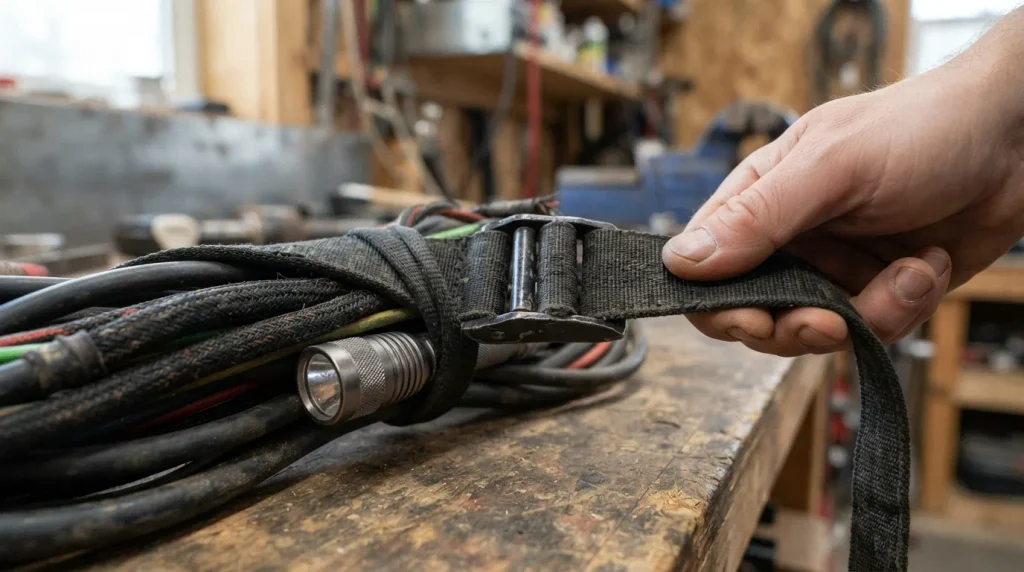
Strap (v.) — US: /stræp/ | UK: /stræp/
- Meaning: To fasten or secure something in place using a flexible band or strap.
- Tone/Register: Practical / Everyday
- Example 1: Make sure to strap the luggage tightly onto the car roof rack.
- Example 2: You should strap the protective helmet on before riding a bike.
Lash (v.) — US: /læʃ/ | UK: /læʃ/
- Meaning: To bind or fasten objects securely together using ropes, cords, or chains.
- Tone/Register: Nautical / Outdoor
- Example 1: Sailors will lash the wooden logs together to build a sturdy raft.
- Example 2: Use heavy rope to lash the tent poles firmly against strong winds.
Harness (v.) — US: /ˈhɑːr.nəs/ | UK: /ˈhɑː.nəs/
- Meaning: To attach hardware securely or capture energy for productive, ongoing use.
- Tone/Register: Technical / Business
- Example 1: Engineers work to harness solar energy to power clean urban transit.
- Example 2: Workers must secure themselves before climbing high towers.
Peg (v.) — US: /pɛɡ/ | UK: /pɛɡ/
- Meaning: To fix or fasten something in position using small wooden or plastic pegs.
- Tone/Register: Practical / Financial
- Example 1: Use wooden stakes to peg the camping tent securely into the ground.
- Example 2: Central banks may peg their currency directly to the foreign dollar.
Stitch (v.) — US: /stɪtʃ/ | UK: /stɪtʃ/
- Meaning: To join fabrics or wound edges together tightly using a needle and thread.
- Tone/Register: Crafting / Medical
- Example 1: Tailors will stitch the leather pieces together to form a sturdy belt.
- Example 2: Doctors had to stitch the deep cut on his arm after the accident.
Knot (v.) — US: /nɑːt/ | UK: /nɒt/
- Meaning: To fasten ropes or strings securely by tying their ends firmly together.
- Tone/Register: Everyday / Crafting
- Example 1: Please knot the string tightly so the package does not open up.
- Example 2: He learned how to knot the climbing ropes safely during training.
Chain (v.) — US: /tʃeɪn/ | UK: /tʃeɪn/
- Meaning: To fasten, bind, or secure something firmly using heavy iron or steel chains.
- Tone/Register: Heavy Practical / Figurative
- Example 1: Always chain your bicycle securely to the iron rack outside.
- Example 2: Heavy obligations can chain a worker to a stressful schedule.
Synonyms for Cement by Tone
- Positive: Bond, Strengthen, Consolidate, Fortify, Ground (evokes unity, growth, and security).
- Neutral: Fasten, Secure, Solidify, Anchor, Attach (focuses on physical action or status update).
- Negative: Entrench, Lock down, Chain, Fetter (can imply restriction or lack of freedom).
- Playful/Informal: Glue, Lock in, Nail down, Paste (casual phrases used in quick conversations).
Understanding tone matters because using a corporate word like consolidate in a personal card sounds robotic, while using glue in a legal contract lacks necessary precision.
Mini Comparison: Solidify vs. Bond vs. Consolidate
| Word | Key Shade of Meaning | Best Context |
| Solidify | Focuses on changing from flexible to firm or final | Finalizing schedules, plans, or physical liquids |
| Bond | Focuses on emotional connection or adhesive attachment | Team building, friendship, or material joining |
| Consolidate | Focuses on merging multiple parts into one power base | Business operations, financial assets, or power |
How “Cement” Changes by Context
- Daily Conversation: Native speakers say “lock in” or “nail down” when making casual plans with friends.
- Writing & Blogging: Authors use “cement” or “solidify” to describe character connections or strong thesis arguments.
- Professional & Academic: Executives use “consolidate” or “cohere” to highlight legal structures and market growth.
- Creative Use: Poets use metaphors like “cementing memories” to dramatize permanence against time.
Common Mistakes & Native Usage Notes
- Mistake 1: Using cement when you mean temporary placement. Cement implies permanent results.
- Mistake 2: Mixing up physical cement (the powder) with concrete (the finished composite material).
- Overuse Warning: Avoid using “cement our relationship” repeatedly in business emails. Switch to strengthen, solidify, or foster.
Learn more about English vocabulary standards through resources like the Cambridge Dictionary.
Real-Life Mini Scenarios
- Workplace: “We need to solidify these project timelines before sending the proposal to our client.”
- Social Situations: “Traveling through Europe helped us bond over shared adventures.”
- Media & Pop Culture: “The championship victory helped cement the athlete’s legacy in sports history.”
Conclusion
Mastering a synonym for cement gives your writing accuracy and vivid emotional tone. Using diverse words helps you avoid boring phrasing while improving your overall communication skills.
Try substituting another synonym for cement into your next business proposal, essay, or casual message. Notice how slight changes in word selection instantly improve your clarity and authority.
Building a strong English vocabulary takes regular, conscious effort across daily contexts. Using a fresh synonym for cement, like solidify or consolidate, will make your writing memorable today!
Interactive Practice Quiz
Test your understanding of synonyms for cement across real-life contexts.
- Which synonym best fits: “The executive wanted to ______ her position in the company before the board meeting.”
- A) Fasten
- B) Consolidate
- C) Glue
- D) Paste
- Select the word that carries an emotional, relationship-focused tone:
- A) Fasten
- B) Bond
- C) Mortar
- D) Anchor
- Choose the best word for physical construction or securing cargo:
- A) Solidify
- B) Fasten
- C) Consolidate
- D) Bond
- Which word implies changing an abstract plan into a fixed arrangement?
- A) Solidify
- B) Glue
- C) Attach
- D) Tie
- “The legal agreement will ______ both parties to the terms.” Which word fits best?
- A) Bond
- B) Bind
- C) Fasten
- D) Cement
- What is the main difference between “bond” and “consolidate”?
- A) Bond is only for metal
- B) Consolidate implies merging parts into a stronger whole
- C) They mean the same thing
- D) Consolidate refers only to liquid physics
- Which informal phrase works as a casual synonym for cement?
- A) Lock in
- B) Break down
- C) Run through
- D) Open up
- Pick the word with the most formal, legal register:
- A) Glue
- B) Bind
- C) Stick
- D) Lock
- Which sentence uses “strengthen” correctly?
- A) We need to strengthen the door lock with glue.
- B) Clear feedback will strengthen our working partnership.
- C) Please fasten your seatbelt now.
- D) The ice will strengthen into rain.
- Which word best describes combining three small departments into one?
- A) Fasten
- B) Consolidate
- C) Bind
- D) Fuse
Application Task: Write a short sentence describing a personal goal using the word solidify.
Answer Key: 1-B, 2-B, 3-B, 4-A, 5-B, 6-B, 7-A, 8-B, 9-B, 10-B
Frequently Asked Questions
What is the most common synonym for cement in business writing?
In professional environments, solidify and consolidate are the most effective options. They convey progress and stability without relying on casual construction metaphors.
Is cement a verb or only a noun?
Cement functions as both a noun and a verb. As a noun, it means the binding powder. As a verb, it means to unite or make permanent.
What is the difference between cement and concrete?
Cement is a fine binding powder mixed with water, sand, and gravel to create concrete. In English writing, “cement” refers to the act of joining or binding.
Can I use “glue” as a direct synonym for cement in academic papers?
No, “glue” is too informal for academic writing. Use refined options like bind, bond, or solidify to maintain a professional tone.
How does learning synonyms for cement improve my vocabulary score?
Using varied vocabulary demonstrates semantic awareness and prevents repetitive phrasing. This improves score performance in writing exams and professional reports.

Sawera Rani is the founder and content creator behind VocabularyFinder.com, a platform designed to help learners improve their English vocabulary simply and effectively. With a passion for language learning, Sawera Rani creates easy-to-understand vocabulary guides, word meanings, definitions, and practical examples that make learning new words easier. She aims to provide useful and reliable resources for students, professionals, and English learners who want to improve their communication skills. Through VocabularyFinder.com, she focuses on making vocabulary learning more accessible, engaging, and helpful for everyday use.