
Many writers search for a synonym for bumbling when describing awkward, clumsy, or stumbling behavior without repeating words.
Imagine Sarah writing a story about a clumsy detective dropping his notebook during a high-stakes investigation. As a result, repeating the word bumbling made her narrative feel dull.
Searching for an accurate synonym for bumbling helped Sarah choose precise terms like blundering, clumsy, or inept for every scene.
Learning a synonym for bumbling expands your vocabulary, sharpens storytelling, and improves daily communication for students, bloggers, and content writers.
What Does “Bumbling” Really Mean?
The word bumbling refers to someone who acts in a clumsy, confused, or ineffective manner while attempting a task. Native speakers understand it as well-meaning yet awkward behavior that leads to minor mistakes. Furthermore, it appears frequently in comedy writing, character descriptions, and casual conversations.
- Part of Speech: Adjective
- Simple Definition: Lacking physical grace, coordination, or administrative effectiveness.
Connotative Meaning
Connotation refers to the implied emotional tone or cultural association that a word carries beyond its literal definition (connotation is the emotional or secondary meaning attached to a word).
- Positive tone: Endearingly clumsy, harmless, amusingly awkward.
- Negative tone: Incompetent, foolish, completely useless.
- Neutral tone: Uncoordinated, unorganized, physically awkward.
Etymology
The word bumbling stems from the Middle English word bumblen, which means to make a humming or booming noise.
- Old English (450–1100): Rooted in early Germanic sound-imitative words describing low, confused noises.
- Middle English (1100–1500): Evolved into bumblen, describing someone moving blindly or making continuous humming sounds.
- Modern English (1500–Present): Shifted toward describing physically clumsy or administratively awkward actions.
Pronunciation & Syllables
- US IPA: /ˈbʌm.blɪŋ/
- UK IPA: /ˈbʌm.blɪŋ/
Syllables: bum-bling
Affixation Pattern:
- Root: Bumble (verb)
- Prefix: None
- Suffix: -ing (adjective suffix denoting continuous action or state)

Synonyms List
Blundering (Adjective) — US: /ˈblʌn.dɚ.ɪŋ/ | UK: /ˈblʌn.dər.ɪŋ/
- Meaning: Making inconsiderate or careless mistakes repeatedly while moving or acting.
- Tone/Register: Neutral, Descriptive, General
- Examples: The blundering assistant dropped the vital files right before the board meeting.
- Consequently, the director had to delay the presentation.
Clumsy (Adjective) — US: /ˈklʌm.zi/ | UK: /ˈklʌm.zi/
- Meaning: Lacking physical skill, grace, or coordination in movement.
- Tone/Register: Everyday, Informal, Common
- Examples: Mark felt unusually clumsy while wearing his new winter boots.
- Therefore, he accidentally tripped over the rug.
Inept (Adjective) — US: /ɪnˈept/ | UK: /ɪnˈept/
- Meaning: Having or showing no skill or competence at a task.
- Tone/Register: Formal, Critical, Academic
- Examples: An inept manager failed to coordinate the department’s schedule properly.
- As a result, several deadlines were missed completely.
Awkward (Adjective) — US: /ˈɑːk.wɚd/ | UK: /ˈɔː.kwəd/
- Meaning: Lacking social poise or physical ease in movements.
- Tone/Register: Everyday, General, Casual
- Examples: The student gave an awkward silence before answering the teacher’s question.
- Thus, the room felt noticeably tense.
Bungling (Adjective) — US: /ˈbʌŋ.ɡəl.ɪŋ/ | UK: /ˈbʌŋ.ɡəl.ɪŋ/
- Meaning: Carrying out a task clumsily or incompetently.
- Tone/Register: Critical, Descriptive, Informal
- Examples: A bungling burglar set off three security alarms within two minutes.
- Hence, police arrived almost instantly.
Ungainly (Adjective) — US: /ʌnˈɡeɪn.li/ | UK: /ʌnˈɡeɪn.li/
- Meaning: Lacking grace or ease of movement in physical appearance.
- Tone/Register: Literary, Formal, Descriptive
- Examples: The young giraffe made ungainly attempts to stand up on the ice.
- Meanwhile, tourists watched with fondness.
Incompetent (Adjective) — US: /ɪnˈkɑːm.pə.t̬ənt/ | UK: /ɪnˈkɒm.pɪ.tənt/
- Meaning: Lacking the necessary ability, qualification, or skill to do something successfully.
- Tone/Register: Harsh, Professional, Formal
- Examples: The court deemed the lawyer incompetent to handle complex financial litigation.
- So, a replacement attorney took over the case.
Gauche (Adjective) — US: /ɡoʊʃ/ | UK: /ɡəʊʃ/
- Meaning: Lacking social grace or ease, resulting in tactless behavior.
- Tone/Register: Elevated, Formal, Literary
- Examples: His gauche remarks embarrassed everyone at the formal dinner table.
- Accordingly, his host changed the subject quickly.
Heavy-Handed (Adjective) — US: /ˌhev.iˈhæn.dɪd/ | UK: /ˌhev.iˈhæn.dɪd/
- Meaning: Clumsy, insensitive, or overly forceful in treatment or handling.
- Tone/Register: Critical, Business, Media
- Examples: The supervisor used a heavy-handed approach when dealing with minor complaints.
- Consequently, staff morale dropped significantly.
Lumbering (Adjective) — US: /ˈlʌm.bɚ.ɪŋ/ | UK: /ˈlʌm.bər.ɪŋ/
- Meaning: Moving in a slow, heavy, and awkward way.
- Tone/Register: Descriptive, Storytelling, Visual
- Examples: A lumbering bear strolled through the campsite in search of food.
- Therefore, campers retreated inside their vehicles.
Oafish (Adjective) — US: /ˈoʊ.fɪʃ/ | UK: /ˈəʊ.fɪʃ/
- Meaning: foolish, unpolished, or physically clumsy like an oaf.
- Tone/Register: Informal, Derogatory, Expressive
- Examples: His oafish behavior caused him to knock over the delicate vase.
- Thus, the host looked visibly disappointed.
Maladroit (Adjective) — US: /ˌmæl.əˈdrɔɪt/ | UK: /ˌmæl.əˈdrɔɪt/
- Meaning: Inefficient or unskillful in physical or social interactions.
- Tone/Register: Academic, High-Formal, Literary
- Examples: She handled the delicate political negotiations in a maladroit manner.
- Besides, key allies felt insulted by her actions.
Uncoordinated (Adjective) — US: /ˌʌn.koʊˈɔːr.də.neɪ.t̬ɪd/ | UK: /ˌʌn.kəʊˈɔː.dɪ.neɪ.tɪd/
- Meaning: Lacking physical harmony or control in muscle movements.
- Tone/Register: Neutral, Medical, General
- Examples: The toddler appeared uncoordinated while attempting to kick the large ball.
- Hence, he fell gently onto the grass.
Inexpert (Adjective) — US: /ɪnˈek.spɝːt/ | UK: /ɪnˈek.spɜːt/
- Meaning: Lacking professional skill, knowledge, or training in a field.
- Tone/Register: Objective, Academic, Professional
- Examples: An inexpert attempt to fix the plumbing caused severe water leaks.
- As a result, a professional plumber had to be called.
Loutish (Adjective) — US: /ˈlaʊ.t̬ɪʃ/ | UK: /ˈlaʊ.tɪʃ/
- Meaning: Unrefined, rude, and physically aggressive or clumsy.
- Tone/Register: Critical, Descriptive, Informal
- Examples: The loutish fans shouted and threw trash across the stadium aisles.
- Consequently, security escorted them outside.
Stumbling (Adjective) — US: /ˈstʌm.blɪŋ/ | UK: /ˈstʌm.blɪŋ/
- Meaning: Moving or speaking hesitantly and with frequent mistakes.
- Tone/Register: Descriptive, Human, Natural
- Examples: He delivered a stumbling speech because he forgot his notes at home.
- Therefore, the audience struggled to understand his main point.
Fumbling (Adjective) — US: /ˈfʌm.blɪŋ/ | UK: /ˈfʌm.blɪŋ/
- Meaning: Handling things clumsily or searching uncertainly with hands.
- Tone/Register: Everyday, Descriptive, Visual
- Examples: She made a fumbling search through her purse to find the house keys.
- Meanwhile, the rain poured down harder.
Unskillful (Adjective) — US: /ʌnˈskɪl.fəl/ | UK: /ʌnˈskɪl.fəl/
- Meaning: Showing a lack of training, technique, or practice.
- Tone/Register: Neutral, Academic, Formal
- Examples: The apprentice made an unskillful cut on the hardwood panel.
- So, the master carpenter demonstrated the step again.
Feckless (Adjective) — US: /ˈfek.ləs/ | UK: /ˈfek.ləs/
- Meaning: Lacking initiative, strength of character, or practical competence.
- Tone/Register: Literary, Critical, Elevated
- Examples: A feckless worker spent hours staring at his screen without completing tasks.
- Thus, his team missed the quarterly quota.

Clueless (Adjective) — US: /ˈkluː.ləs/ | UK: /ˈkluː.ləs/
- Meaning: Completely lacking knowledge, awareness, or understanding about a situation.
- Tone/Register: Casual, Conversational, Informal
- Examples: The new employee looked clueless during his first software training session.
- However, his mentor guided him patiently.
Wooden (Adjective) — US: /ˈwʊd.ən/ | UK: /ˈwʊd.ən/
- Meaning: Stiff, unnatural, or lacking flexibility in movement or acting.
- Tone/Register: Critical, Artistic, Media
- Examples: The lead actor gave a wooden performance during the opening night.
- Consequently, critics gave the play mixed reviews.
Heavy-Footed (Adjective) — US: /ˌhev.iˈfʊt̬.ɪd/ | UK: /ˌhev.iˈfʊt.ɪd/
- Meaning: Walking heavily, loudly, or without lightness and grace.
- Tone/Register: Descriptive, Casual, Storytelling
- Examples: A heavy-footed neighbor walked loudly across the wooden floorboards upstairs.
- Therefore, sleeping downstairs proved difficult.
Butter-Fingered (Adjective) — US: /ˈbʌt̬.ɚˌfɪŋ.ɡɚd/ | UK: /ˈbʌt.əˌfɪŋ.ɡəd/
- Meaning: Prone to dropping objects frequently due to carelessness or poor grip.
- Tone/Register: Idiomatic, Playful, Informal
- Examples: Our butter-fingered goalkeeper let the ball slip right past his hands.
- As a result, the opposing team scored easily.
Graceless (Adjective) — US: /ˈɡreɪs.ləs/ | UK: /ˈɡreɪs.ləs/
- Meaning: Devoid of elegance, charm, or smooth movement.
- Tone/Register: Formal, Critical, Literary
- Examples: His graceless departure from the meeting offended several senior executives.
- So, company leaders questioned his maturity.
Floundering (Adjective) — US: /ˈflaʊn.dɚ.ɪŋ/ | UK: /ˈflaʊn.dər.ɪŋ/
- Meaning: Struggling helplessly or clumsily in water, mud, or complex tasks.
- Tone/Register: Expressive, Descriptive, Business
- Examples: The floundering company attempted to launch three products simultaneously without research.
- Consequently, revenues dropped sharply.
Inapt (Adjective) — US: /ɪnˈæpt/ | UK: /ɪnˈæpt/
- Meaning: Unsuited or inappropriate for a particular purpose or situation.
- Tone/Register: Formal, Academic, Precise
- Examples: His inapt choice of words during the ceremony caused widespread confusion.
- Hence, the organizer issued a clarification.
Clodhopping (Adjective) — US: /ˈklɑːdˌhɑː.pɪŋ/ | UK: /ˈklɒdˌhɒp.ɪŋ/
- Meaning: Moving heavily, awkwardly, or foolishly in rural or rustic settings.
- Tone/Register: Informal, Old-Fashioned, Storytelling
- Examples: The clodhopping farmhand stumbled through the muddy field with heavy buckets.
- Besides, he spilled water everywhere.
Blunderheaded (Adjective) — US: /ˈblʌn.dɚˌhed.ɪd/ | UK: /ˈblʌn.dərˌhed.ɪd/
- Meaning: Habitually foolish, prone to ignorant blunders, and unthinking.
- Tone/Register: Informal, Humorous, Descriptive
- Examples: A blunderheaded driver parked across two spaces near the main entrance.
- Thus, shoppers voiced their frustration.
Tactless (Adjective) — US: /ˈtækt.ləs/ | UK: /ˈtækt.ləs/
- Meaning: Showing a lack of sensitivity or skill in dealing with others.
- Tone/Register: Social, Critical, Everyday
- Examples: Her tactless comments regarding his job loss created immense tension.
- Therefore, an uncomfortable atmosphere filled the room.
All-Thumbs (Adjective) — US: /ˌɑːlˈθʌmz/ | UK: /ˌɔːlˈθʌmz/
- Meaning: Clumsy and awkward with one’s hands when handling physical objects.
- Tone/Register: Idiomatic, Conversational, Friendly
- Examples:I felt completely all-thumbs while trying to tie the tiny wedding bows.
- So, my sister completed the crafts for me.
Unhandy (Adjective) — US: /ʌnˈhæn.di/ | UK: /ʌnˈhæn.di/
- Meaning: Not clever or convenient in using the hands or tools.
- Tone/Register: Informal, Descriptive, Casual
- Examples: He proved unhandy with basic home repairs, needing help to assemble shelves.
- Consequently, he called a local repair service.
Green (Adjective) — US: /ɡriːn/ | UK: /ɡriːn/
- Meaning: Inexperienced, naive, and prone to beginner mistakes.
- Tone/Register: Metaphorical, Worksite, Everyday
- Examples: The green recruit dropped his gear twice during the first drill.
- However, the drill sergeant remained patient.
Inarticulate (Adjective) — US: /ˌɪn.ɑːrˈtɪk.jə.lət/ | UK: /ˌɪn.ɑːˈtɪk.jə.lət/
- Meaning: Unable to express feelings or ideas clearly through spoken words.
- Tone/Register: Academic, Critical, Formal
- Examples: An inarticulate response left the board members uncertain about his strategy.
- Thus, approval was delayed.
Slow-Witted (Adjective) — US: /ˌsloʊˈwɪt̬.ɪd/ | UK: /ˌsləʊˈwɪt.ɪd/
- Meaning: Slow to understand, think, or respond to dynamic situations.
- Tone/Register: Informal, Critical, Descriptive
- Examples: The slow-witted character in the sitcom provided consistent comedic relief.
- As a result, audiences found him amusing.
Unpolished (Adjective) — US: /ʌnˈpɑː.lɪʃt/ | UK: /ʌnˈpɒl.ɪʃt/
- Meaning: Lacking sophistication, elegance, or refined social skill.
- Tone/Register: Neutral, Professional, Constructive
- Examples: His unpolished presentation style needed work before meeting major investors.
- Therefore, he practiced with a speech coach.
Muddle-Headed (Adjective) — US: /ˌmʌd.əlˈhed.ɪd/ | UK: /ˌmʌd.əlˈhed.ɪd/
- Meaning: Mentally confused, disorganized, or lacking clear logical thought.
- Tone/Register: Informal, Descriptive, Critical
- Examples: A muddle-headed plan resulted in two teams working on the same task.
- Hence, precious company time was wasted.
Blockish (Adjective) — US: /ˈblɑː.kɪʃ/ | UK: /ˈblɒk.ɪʃ/
- Meaning: Unresponsive, uninformed, or wooden in manner and movement.
- Tone/Register: Literary, Old-Fashioned, Critical
- Examples: The blockish guard stood silently without acknowledging the visitor’s request.
- Consequently, the traveler sought help elsewhere.
Ham-Fisted (Adjective) — US: /ˌhæmˈfɪs.tɪd/ | UK: /ˌhæmˈfɪs.tɪd/
- Meaning: Clumsy, awkward, or lacking delicate control in actions or words.
- Tone/Register: Informal, Critical, Expressive
- Examples: His ham-fisted attempt at fixing the delicate clock broke the main spring.
- So, the antique lost its value.
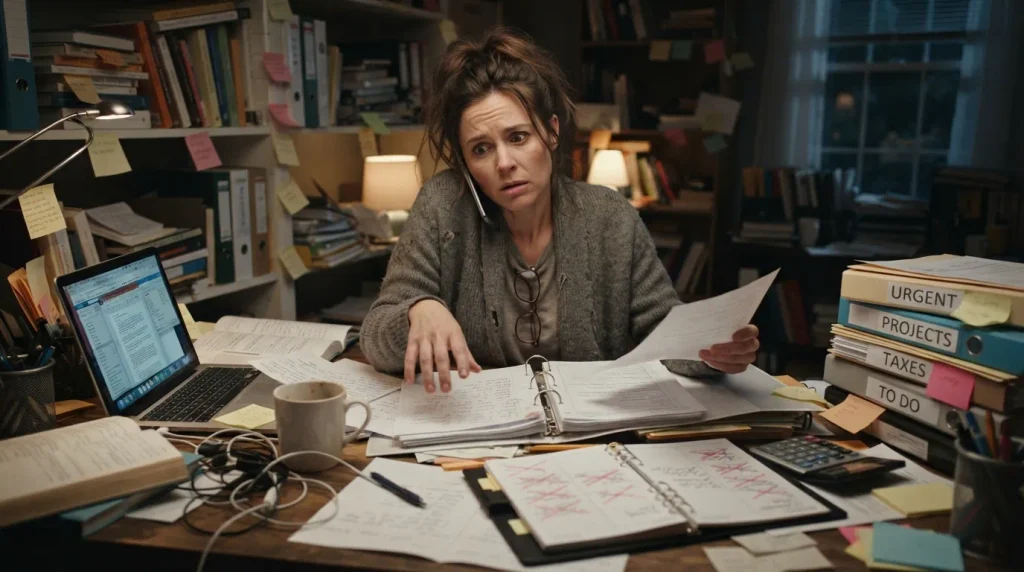
Scatterbrained (Adjective) — US: /ˈskæt̬.ɚ.breɪnd/ | UK: /ˈskæt.ə.breɪnd/
- Meaning: Disorganized, incapable of serious thought, and constantly forgetting things.
- Tone/Register: Conversational, Everyday, Mild
- Examples: My scatterbrained roommate misplaced her car keys three times today.
- Therefore, we left for dinner late.
Undeft (Adjective) — US: /ʌnˈdeft/ | UK: /ʌnˈdeft/
- Meaning: Lacking skill, quickness, or neatness in physical or manual tasks.
- Tone/Register: Literary, Formal, Rare
- Examples: An undeft stroke of the brush ruined the fine lines of the portrait.
- As a result, the artist restarted the canvas.
Heavy-Handed (Adjective) — US: /ˌhev.iˈhæn.dɪd/ | UK: /ˌhev.iˈhæn.dɪd/
- Meaning: Lacking subtlety, sensitivity, or gentle dexterity in execution.
- Tone/Register: Critical, Professional, Editorial
- Examples: The editor made heavy-handed cuts that ruined the author’s delicate style.
- Thus, readers complained about the jumpy narrative.
Unnimble (Adjective) — US: /ʌnˈnɪm.bəl/ | UK: /ʌnˈnɪm.bəl/
- Meaning: Lacking quickness, lightness, or agility in movement or thought.
- Tone/Register: Formal, Descriptive, Uncommonly Used
- Examples: An unnimble climber struggled to navigate the steep, rocky slope.
- Meanwhile, the rest of the group waited safely below.
Thick-Fingered (Adjective) — US: /ˌθɪkˈfɪŋ.ɡɚd/ | UK: /ˌθɪkˈfɪŋ.ɡəd/
- Meaning: Having thick fingers, making delicate or small handling tasks difficult.
- Tone/Register: Descriptive, Informal, Practical
- Examples: The thick-fingered worker found it hard to repair the small smartphone screws.
- Hence, he used specialized magnetic tweezers.
Awkward-Handed (Adjective) — US: /ˈɑːk.wɚdˌhæn.dɪd/ | UK: /ˈɔː.kwədˌhæn.dɪd/
- Meaning: Handling items or tools without natural ease, skill, or dexterity.
- Tone/Register: Descriptive, Casual, Regional
- Examples: An awkward-handed painter spilled a drop of green enamel onto the carpet.
- Therefore, he scrubbed the floor immediately.
Half-Baked (Adjective) — US: /ˌhæfˈbeɪkt/ | UK: /ˌhɑːfˈbeɪkt/
- Meaning: Not fully thought out, planned, or executed with skill and logic.
- Tone/Register: Informal, Critical, Business
- Examples: The team presented a half-baked marketing strategy during the client pitch.
- Consequently, the client declined the proposal.
Synonyms by Tone
Positive Tone
- Endearingly Clumsy: Implies charm, innocence, and lovable harmlessness.
- Green: Suggests youth, freshness, and room for professional growth.
- Unpolished: Reflects raw potential that merely needs refinement.
Neutral Tone
- Uncoordinated: Objective medical or physical description without judgment.
- Unskillful: Clear, matter-of-fact assessment of current ability.
- Inexpert: Professional observation regarding lack of specialized training.
Negative Tone
- Incompetent: Severe assessment implying complete inability to perform duties.
- Feckless: Critical term suggesting lack of character, drive, and skill.
- Gauche: Social disapproval targeting tactless behavior in polite society.
Playful / Informal Tone
- Butter-Fingered: Lighthearted, humorous description of dropping items.
- All-Thumbs: Friendly, self-deprecating expression for physical awkwardness.
- Clodhopping: Amusing, vivid description of rustic, heavy movement.
Selecting the correct tone ensures effective communication. Describing a colleague as “all-thumbs” creates a friendly atmosphere, whereas labeling them “incompetent” damages professional relationships.
Mini Comparison
Bumbling vs. Inept vs. Clumsy
| Feature | Bumbling | Inept | Clumsy |
| Primary Focus | Well-meaning yet confused execution | Total lack of skill or capacity | Physical lack of coordination |
| Tone | Mild, humorous, or descriptive | Formal, critical, and severe | Common, neutral, and physical |
| Best Context | Comedic storytelling & light criticism | Professional evaluations & reports | Daily physical mishaps & sports |
- Bumbling: Use when describing someone acting with good intentions who creates mild confusion through awkward actions.
- Inept: Use when making a serious, professional judgment about someone’s total failure in duty.
- Clumsy: Use when referring specifically to physical awkwardness, like tripping or dropping objects.
Context-Based Usage
Daily Conversation
In casual chats, people describe daily physical mishaps using friendly terms like clumsy, all-thumbs, or butter-fingered. For example, someone might say, “I was all-thumbs this morning and spilled coffee everywhere.”
Writing or Blogging
Content writers use engaging terms like bumbling, stumbling, or unpolished. These words capture reader interest while describing relatable human errors without sounding overly academic.
Professional or Academic Tone
In formal reports, choose precise terms like inexpert, maladroit, or unskillful. Consequently, these words convey clear assessments while maintaining professional boundaries.
Creative or Informal Use
Fiction authors build memorable characters using rich descriptors like lumbering, gauchy, or clodhopping. Thus, readers visualize character movements clearly within stories.
Common Mistakes & Native Usage
Common Mistakes Learners Make
- Calling a friend “incompetent” casually: This word carries severe negative weight in English. Use “clumsy” or “all-thumbs” instead.
- Confusing clumsy with careless: Clumsy refers to physical movement, whereas careless refers to lack of attention.
- Overusing generic words: Replace basic words with expressive choices like fumbling, wooden, or floundering to improve your prose.
Register Notes
In written English, terms like maladroit and feckless convey high authority. In spoken English, phrases like all-thumbs or clueless sound natural and relatable.
(For additional vocabulary resources, explore our detailed professional English guides.)
Real-Life Mini Scenarios
Workplace
An apprentice makes a fumbling attempt to organize warehouse inventory. Consequently, the team supervisor steps in to provide clear instructions.
Social Situations
A guest makes an awkward comment about the host’s cooking. Therefore, a friend smoothly redirects the dinner conversation.
Media & Pop Culture
A classic comedy features a bumbling detective who solves cases entirely by accident. As a result, audiences laugh at his daily mistakes.
Writing & Storytelling
A novelist portrays a lumbering giant stepping through a dense forest. Thus, readers visualize every heavy step clearly.
Interactive Practice Quiz
- Which term best describes a person who frequently drops physical objects?
a) Maladroit
b) Butter-fingered
c) Wooden
d) Gauche - A formal word indicating a complete lack of skill in professional tasks is:
a) All-thumbs
b) Inept
c) Clodhopping
d) Green - Which word carries a positive or endearingly mild tone?
a) Feckless
b) Unpolished
c) Incompetent
d) Loutish - What is the key difference between bumbling and clumsy?
a) Bumbling involves mental confusion and awkward action; clumsy focuses mainly on physical movement
b) Clumsy is always formal
c) Bumbling only applies to software
d) There is no difference - An informal phrase used when your hands feel awkward while working is:
a) All-thumbs
b) Maladroit
c) Inapt
d) Heavy-handed - Which term fits best in a literary story describing a heavy, slow animal?
a) Lumbering
b) Tactless
c) Gauche
d) Green - What tone does “incompetent” carry in workplace reviews?
a) Highly positive
b) Playful slang
c) Harsh and critical
d) Neutral - Which synonym describes someone lacking social grace or etiquette?
a) Gauche
b) Fumbling
c) Butter-fingered
d) Heavy-footed - A beginner who makes mistakes due to lack of experience is often called:
a) Feckless
b) Green
c) Oafish
d) Maladroit - Setting up a temporary speech without preparation can lead to a __________ delivery.
a) Stumbling
b) Lumbering
c) Clodhopping
d) Heavy-handed
Reflection Task
Write two original sentences describing a funny or awkward situation. Use a synonym for bumbling from this guide in each sentence, ensuring the tone fits your context.
Answer Key:
1: b | 2: b | 3: b | 4: a | 5: a | 6: a | 7: c | 8: a | 9: b | 10: a
Frequently Asked Questions
1. What is the most common casual synonym for bumbling in daily conversation?
The most common casual synonym for bumbling in daily conversation is clumsy or awkward. Native speakers use these terms frequently to describe minor physical accidents, tripping, or dropping items in everyday settings.
2. Can I use “feckless” in business reports to describe poor performance?
While feckless is grammatically correct, it carries a strong literary and critical tone that may sound overly emotional. In business reports, use objective terms like unskillful, inefficient, or inexpert instead.
3. How does “maladroit” differ from basic physical clumsiness?
Maladroit refers to both physical awkwardness and social or political lack of skill. Unlike basic clumsiness, it often describes tactless handling of sensitive situations, diplomatic efforts, or complex human interactions.
4. What are good literary synonyms for bumbling in fiction writing?
In fiction writing, words like bungling, lumbering, ungainly, or oafish add vivid sensory detail. These terms help readers visualize character movements, body language, and physical presence effectively.
5. Why does using varied synonyms for bumbling improve SEO content quality?
Using diverse semantic choices like blundering, inept, and awkward prevents repetitive language. Furthermore, it demonstrates broad topical depth to search engines, helping your content rank naturally across related search queries.
Conclusion
Expanding your vocabulary with a synonym for bumbling allows you to describe awkward situations, physical mistakes, and character traits with vivid accuracy.
Mastering every synonym for bumbling helps you express ideas clearly across creative stories, professional documents, and daily conversations.
Start using each synonym for bumbling in your daily writing today to refine your English communication, build writing confidence, and engage readers effectively!

Sawera Rani is the founder and content creator behind VocabularyFinder.com, a platform designed to help learners improve their English vocabulary simply and effectively. With a passion for language learning, Sawera Rani creates easy-to-understand vocabulary guides, word meanings, definitions, and practical examples that make learning new words easier. She aims to provide useful and reliable resources for students, professionals, and English learners who want to improve their communication skills. Through VocabularyFinder.com, she focuses on making vocabulary learning more accessible, engaging, and helpful for everyday use.